What Grows in Weary Lands: On Christian Resilience by Tish Harrison Warren
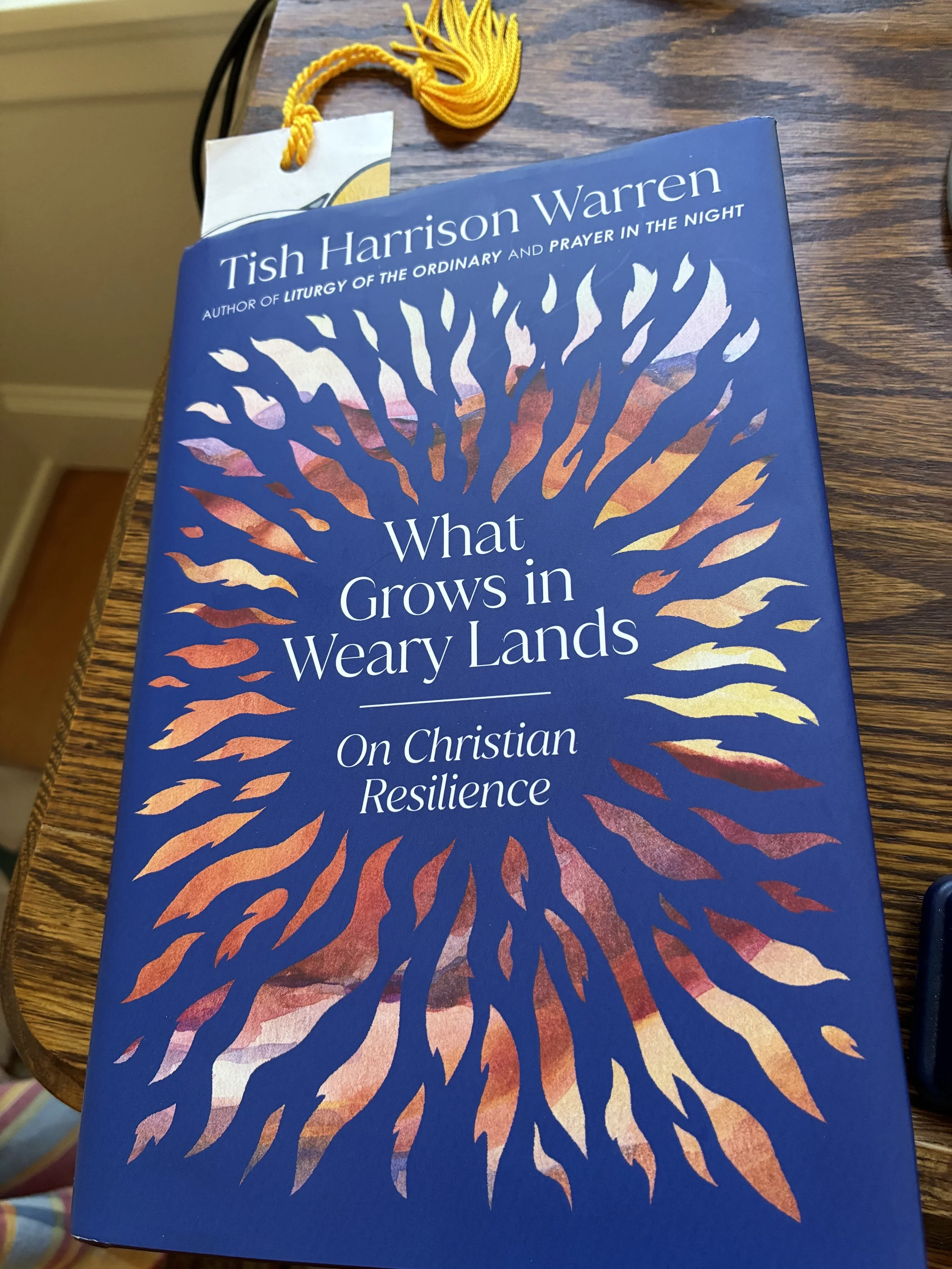
What Grows in Weary Lands: On Christian Resilience - 5*
Tish Harrison Warren
I almost didn’t write this book’s subtitle in my blog/newsletter title. I think “resilience” is not a good word to encapsulate what Warren wrote about in What Grows in Weary Lands. Her first sentence talks about the weariness she explores:
Though we experience this differently, all of us hit points in our lives where we’re out of steam, where we can’t get traction, where we feel lifeless or tired, disoriented and unsure of ourselves. Things seem hard, maybe harder than we think they should be. —page 5
Warren wrote this while in this kind of weary time. She had written for the New York Times for two years, which meant a weekly deadline and much attention. She was:
always worrying over something or other. The online critics, whose voices echoed in my head like some kind of demon parrot who only knew insults. Or the headlines that blared on my news feed. Or the feuding state of the American church. Or my slowing metabolism and sudden appearance of gray hair.
She was also in that “sandwich generation” time — with three children and a mother with Alzheimers. From other writers trying to describe it, Warren called her feeling “languishing,” “twilight space between depression and flourishing,” “dark night,” “desolation,” and “drooping spirits (page 13),” among others, and said:
This book is about the perseverance it takes not just to endure but to embrace the middle. It is about what the Christian tradition often called fortitude but we now more commonly name resilience. —page 14
Years ago, I read Katherine Norris’ book Acedia and Me, about her struggle with acedia, which seemed similar to what I was reading in Tish Harrison Warren’s book. Warren said it was different, though.
[Acedia] has to do with an internal state of restlessness, boredom, cynicism, and futility. It is a lack of motivation…My favorite definition, however, comes from John Paul II: ‘a sadness arising from the fact that the good is difficult.’ —page 27
…Aridity [a word Warren uses often for this feeling she writes about] is more like a spiritual environment—a season of disorientation when we sense God’s absence, even if we still feel desire for God. —pages 27-28
Warren uses wisdom from the Desert Fathers and Mothers. When she started learning about them, she wrote:
Three things were clear: First, these were the weirdest people I’d ever encountered. Second, they understood what languishing boredom, and burnout felt like, and they wrote about these experiences in ways that felt surprisingly contemporary. And, finally, I sensed that they understood, in a way I did not, what was happening inside of me.
The Desert Fathers and Mothers were early Christian monks (third and fourth centuries) who “left the cities and towns where they lived and moved to the desolate expanses of Syria, Palestine, and especially Egypt.” They practiced “repetitive rhythms of prayer and work." Many were illiterate, but some who were educated “wrote down the sayings, stories, and proverbs that had been passed around this community” (page 17).
People, even great leaders, often traveled great distances to learn from these scholars.
To everyone’s disappointment, there is no secret knowledge. There is no spiritual or emotional shortcut where we skip over the long way of practice into perpetual contentment, joy, and awe. There are no cheat codes in the Christian life. And there’s no shortcut in the desert. We must go through it, not around it. =-page 21
Bummer. Wouldn’t a shortcut or secret code for joy and contentment forever be great?
Warren says she has come to believe that when life stretches on and we meet with suffering, sadness, or “simply the cussedness of living,…people can respond in three ways” (page 22).
Flame out - exploding their own lives without much thought of the collateral damage.
Numb out - anesthetize themselves through food, drink, work, shopping, screens, or other easy comforts.
Or, ‘by God’s grace, there’s the third option: Go deep.’ —page 23
Going deep means looking honestly at the truth of things—
the pain in our lives, the sins and weaknesses in ourselves and those around us…learning to receive anew the rich goodness of life,…remain with the difficult questions, relationships, practices, and commitments, while also remaining alive to God and to ourselves. It requires us to learn to exist, and to thrive, in places of incompleteness, unfulfillment, liminality, and uncertainty. —page 23
When a monk was suffering from aridity, the advice from the Desert Fathers and Mothers was
‘stay in your cell,’ literally meaning stay in your room and persist in your daily habits of prayer and work. It was a call to be steadfast regardless of how you felt. —page 28
It was “an invitation to the deep internal work that only happens in us with patience, struggle, and perseverance” (page 29).
I thought of phrases like “going through the motions” and “fake it till you make it,” but it was interesting to me that Warren described this act of persisting in your daily habits as worshiping with your body, even if you may not feel it in your heart.
In the liturgy, we make the sign of the cross, we lift up our hands to receive a blessing, we pass the peace, we receive Communion, we pray prayers that we’ve been given. However I may feel about prayer on any given Sunday, I kneel. I bend my knees. And if my heart will not submit to God, my body leads the way. I take the Eucharist, and even if I cannot feel the presence of Christ, I receive him in my hands, on my tongue.
…Pray with your body…and your soul eventually catches up. Eugene Peterson says, ‘Act your gratitude; pantomime your thanks; you will become that which you do.’ This is one of the gifts that perseverance gives us. —page 35
I could go on and on. Warren is one of my favorite writers. I think I have read all her books, and I missed her voice when she stopped writing in the New York Times. In this book, she said, “Staying in our cell is to meet God not in how our life could be or should be but in what it actually is, today, in this moment” (page 37). This is what Warren writes about: living in Christ and Christ living in us as we live our actual life, what it is, reality.