When Women Were Birds: Fifty-four Variations on Voice by Terry Tempest Williams
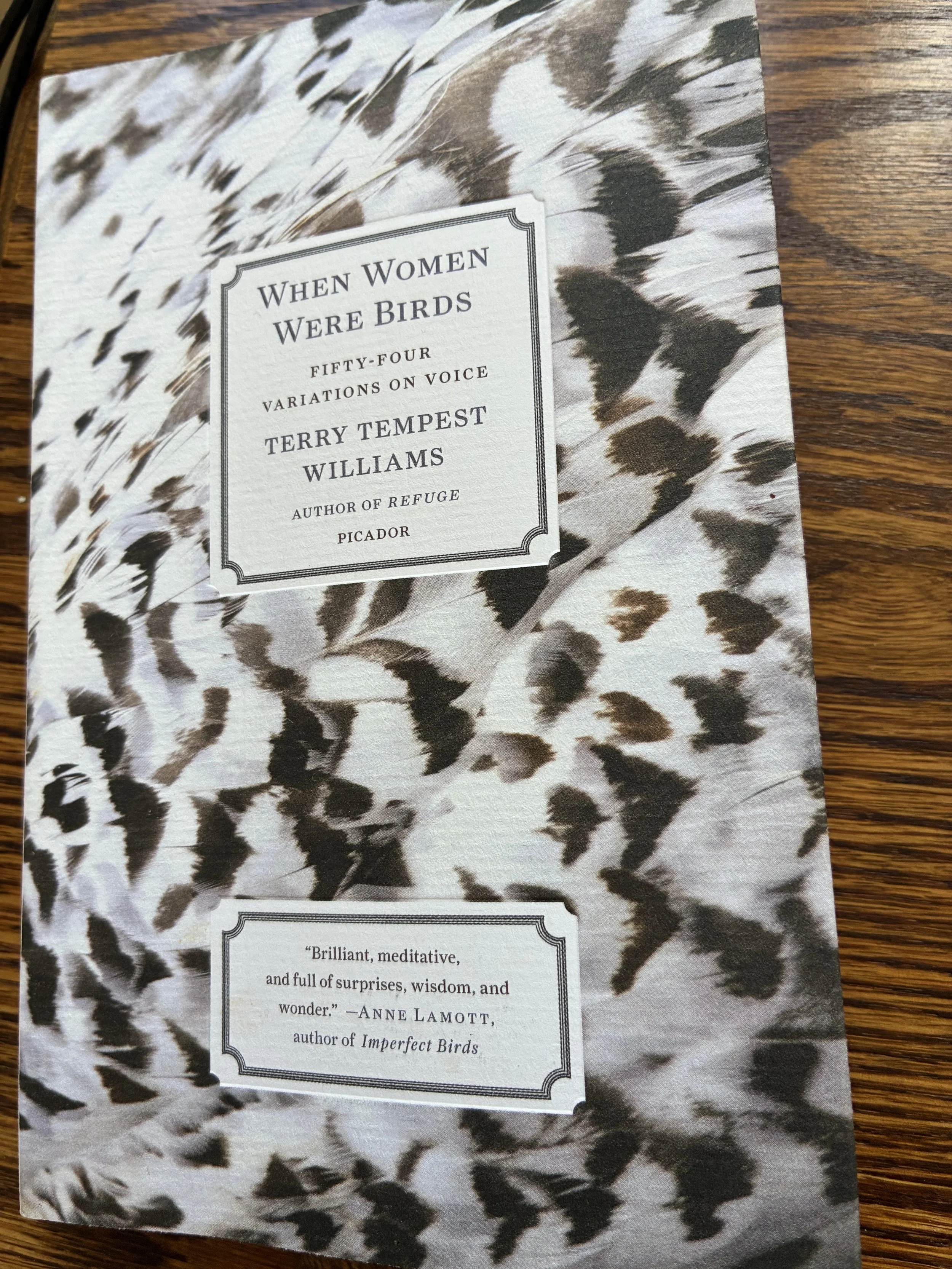
When Women Were Birds: Fifty-four Variations on Voice - 5*
Terry Tempest Williams
Strange title, right? I’m not real sure why it’s called that, but I think it has something to do with women’s voices and lives somehow being similar to birds’. Near the beginning of the book, Williams writes:
I didn’t realize how young she [Williams’ mother] was, but isn’t that the conceit of mothers—that we conceal our youth and exist only for our children? It is the province of mothers to preserve the myth that we are unburdened with our own problems…When women were birds, we knew otherwise. We knew our greatest freedom was in taking flight at night, when we could steal the heavenly darkness for ourselves,…in the delight and terror of our uncertainty. —pages 15-16
Another strange thing is that Williams uses her mother’s journals as the backbone of her reflections, and the journals were all blank. I never knew this, but: “In Mormon culture, women are expected to do two things: keep a journal and bear children” (page 18). I was so surprised, I googled it and, sure enough, I found many sources confirming that keeping a journal is an expectation for women in the Mormon tradition. Williams says journal-keeping is “a participatory bow to the past and future. In telling a story, personal knowledge and continuity are maintained” (page 18). Interesting!
But her mother’s journals were empty! On the first page, Williams writes about her mother’s death at fifty-four years old (I just connected the dots on why the book has “Fifty-four Variations on Voice”):
‘I am leaving you all my journals,’ she said, facing the shuttered window as I continued rubbing her back. ‘But you must promise me that you will not look at them until after I am gone.’
I gave her my word. And then she told me where they were. I didn’t know my mother kept journals.
A week later she died. —page 1
…
On the next full moon I found myself alone in the family home. I kept expecting Mother to appear. Her absence became her presence. It was the right time to read her journals. They were exactly where she said they would be: three shelves of beautiful clothbound books, some paisley, others in solid colors. The spines were perfectly aligned. I opened the first journal. It was empty. I opened the second journal. It was empty. I opened the third. It, too, was empty, as were the fourth, the fifth, the sixth—shelf after shelf after shelf, all my mother’s journals were blank. —page 2
I do not know why my mother bought journal after journal, year after year, and never wrote in one of them and passed them on to me.
I will never know
The blow of her blank journals became a second death.
My Mother’s Journals are paper tombstones. —page 15
Wow. A lot of gems there. This book is full of gems — sentences that seem to glow from the page.
Williams kept journals, too, and said, “I have experienced each encounter in my life twice: once in the world, and once again on the page” (page 33). I have heard other writers worry about this phenomenon of life experienced and life on the page. One said he realized that as he lived his life, he was constantly thinking, “This will be a good thing to write about.” It made him concerned he wasn’t experiencing life for itself, but only as fodder for his writing. A legitimate concern, but I don’t think that is what Williams meant. I think she probably enjoys reliving her experiences on the page. Once in a while, when I am strongly feeling something in life — joy, sadness, awe — I will think, “I can’t wait to write about this,” or “I wonder how I can write about this so it conveys what I’m feeling.”
In each of the fifty-four reflections, Williams includes a sentence (or several) about her mother’s journals.
My Mother’s Journals are theatrical.
My Mother’s Journals are a transgression.
My Mother’s Journals are a scandal of white.
My Mother’s Journals are a ‘harmony of silence.’
My Mother’s Journals are paper cranes.
My Mother’s Journals are a collection of white handkerchiefs.
Sometimes a whole page.
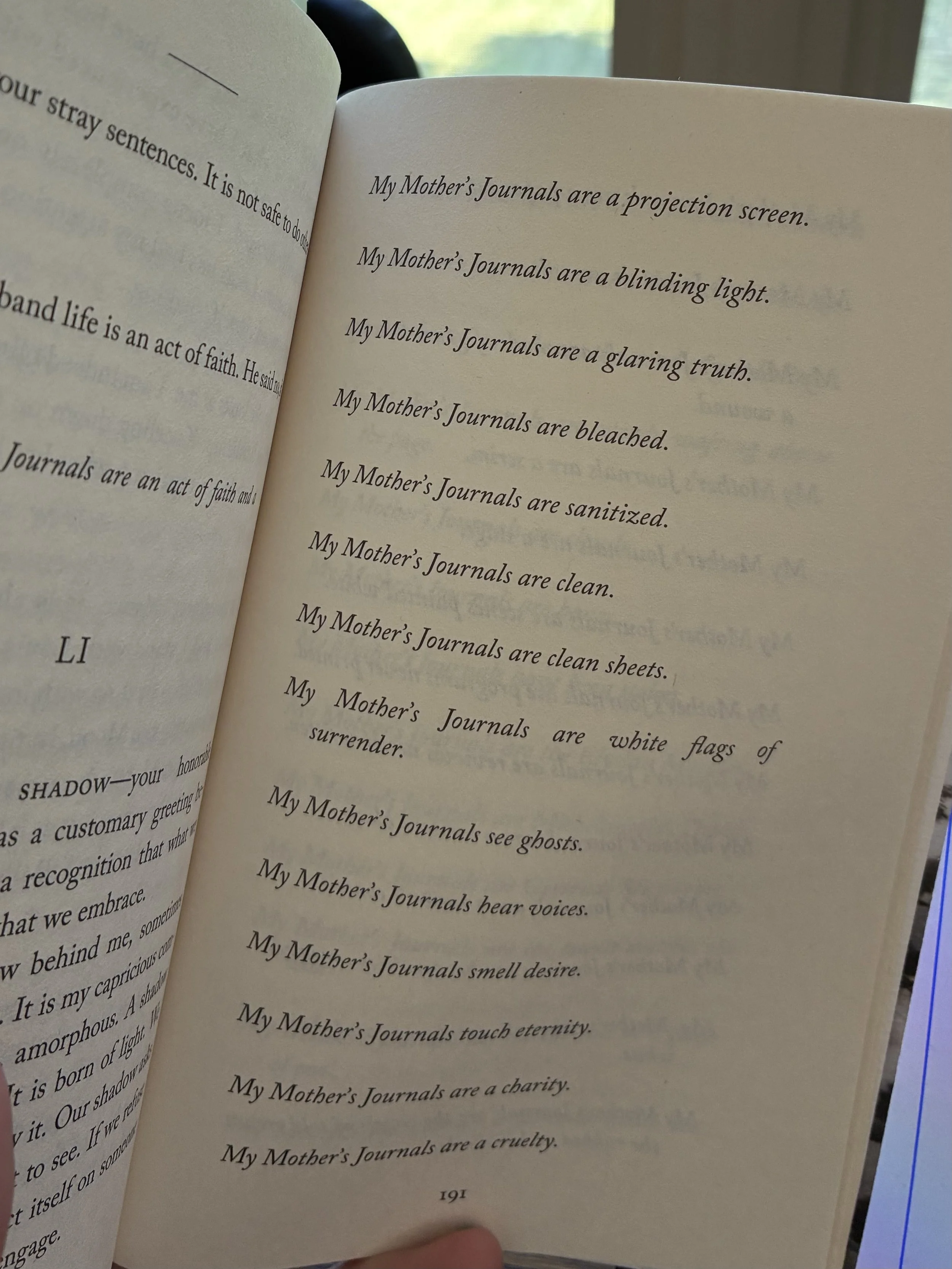
Astonishing how much she drew from blank pages.
I liked this book. It kept me interested and engaged. I read it quite quickly because I kept wanting to read the next thing — turn the next page. That’s the mark of good writing. I just read an author who said the whole point of writing is to keep the reader wanting to turn the page.
The last paragraph of the book is another gem.
Once upon a time, when women were birds, there was the simple understanding that to sing at dawn and to sing at dusk was to heal the world through joy. The birds still remember what we have forgotten, that the world is meant to be celebrated. —page 225