Van Gogh Has a Broken Heart: What Art Teaches us About the Wonder and Struggle of Being Alive by Russ Ramsey
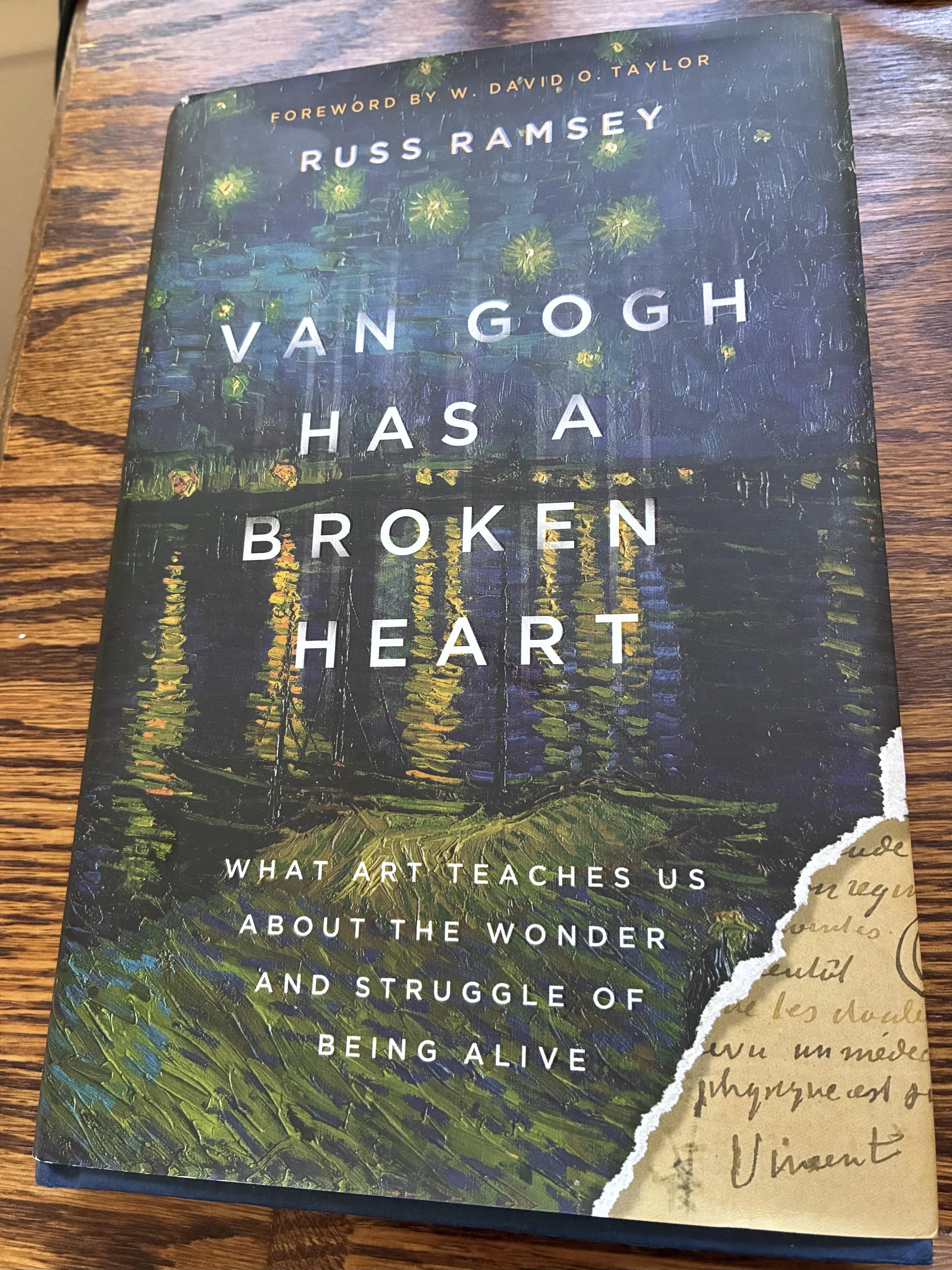
Van Gogh Has a Broken Heart: What Art Teaches Us About the Wonder and Struggle of Being Alive - 5*
Russ Ramsey
In the video linked above, Ramsey says, “Art in its essence is really storytelling.” I hadn’t thought of that before; have you? Rather than a picture or an image or a sculpture or whatever, it’s interesting to wonder, “What story is this telling me?”
Also in the video, Ramsey tells us one of his teachers said,
If you want to have a lifelong relationship with the arts, find an artist that you connect with and then just pay attention to them for the rest of your life" and they will introduce you around. They'll introduce you to their friends and colleagues on the gallery walls next to them. You'll read the plaques, and you'll learn who their mentors were. And then before you know it, they will have introduced you around to a community of people that will then further introduce you around.
He says his “docents” in his relationship with the arts have been Van Gogh and Rembrandt. I read another of his books, Rembrandt is in the Wind: Learning to Love Art Through the Eyes of Faith, too, and enjoyed it, too.
Ramsey introduces himself as a farmer and a pastor, and he says farmers are storytellers. Hmm, never thought about that, either. I appreciate that his faith flavors his thoughts about art.
This book is a collection of stories of several artists. In his foreword, W. David O. Taylor says,
Ramsey gives us here a collection of stories—of Doré and Degas, of Gauguin and Gentileschi—that together convey a truth that can only be revealed properly in this way: namely, that our sorrows are hallowed by the One who enters fully into the painful stories of our own lives in order to show us that our suffering matters, while also becoming the place from which the Spirit enables us to become agents of God’s healing grace to those who find themselves lost and alone in their griefs. ~Page xii
Holy sorrows.
The book contains many pictures. I read it with a magnifying glass so I could look closely at the details. I also googled some of the art, which enabled me to look more closely as well. Googling is always a risk—you often get distracted and start looking at other things like emails, texts, etc. At least I do.
There was an interesting discussion of the difference between beauty and the sublime.
Beauty is a subset of the sublime, but the sublime is always greater than mere beauty…
[Quoting a philosopher named Edmund Burke:] Burke’s contention was that we…define beauty in terms of physical attraction. In a male-dominated society, then, beauty is governed by what men find desireable in women: smoothness, gentleness, softness, and so on… When we admire something for beauty alone,…often our instinct will be to attempt to possess it.
The sublime, on the other hand, cannot be possessed. It is, by nature, greater than us.
Whatever makes us feel small in the universe question our ultimate significance, experience existential helplessness, or fear the magnificent power of nature belongs to the sublime…a sort of delightful horror; a sort of tranquility tinged with terror. ~Pages 102, 103
The chapter on Van Gogh begins with a quote from one of his letters to his brother Theo:
Oh, if I could have worked without this accursed disease—what things I might have done. ~Page 114
Doesn’t that make you sad? No one gets the life they hope for, do they?
People joke about Van Gogh cutting off his ear and giving it to a woman, but there is so much more to the story. Van Gogh wanted to “live the life of an artist,” and dreamed of living with a group of artists in a house in Arles, France—the “Yellow House” he painted.
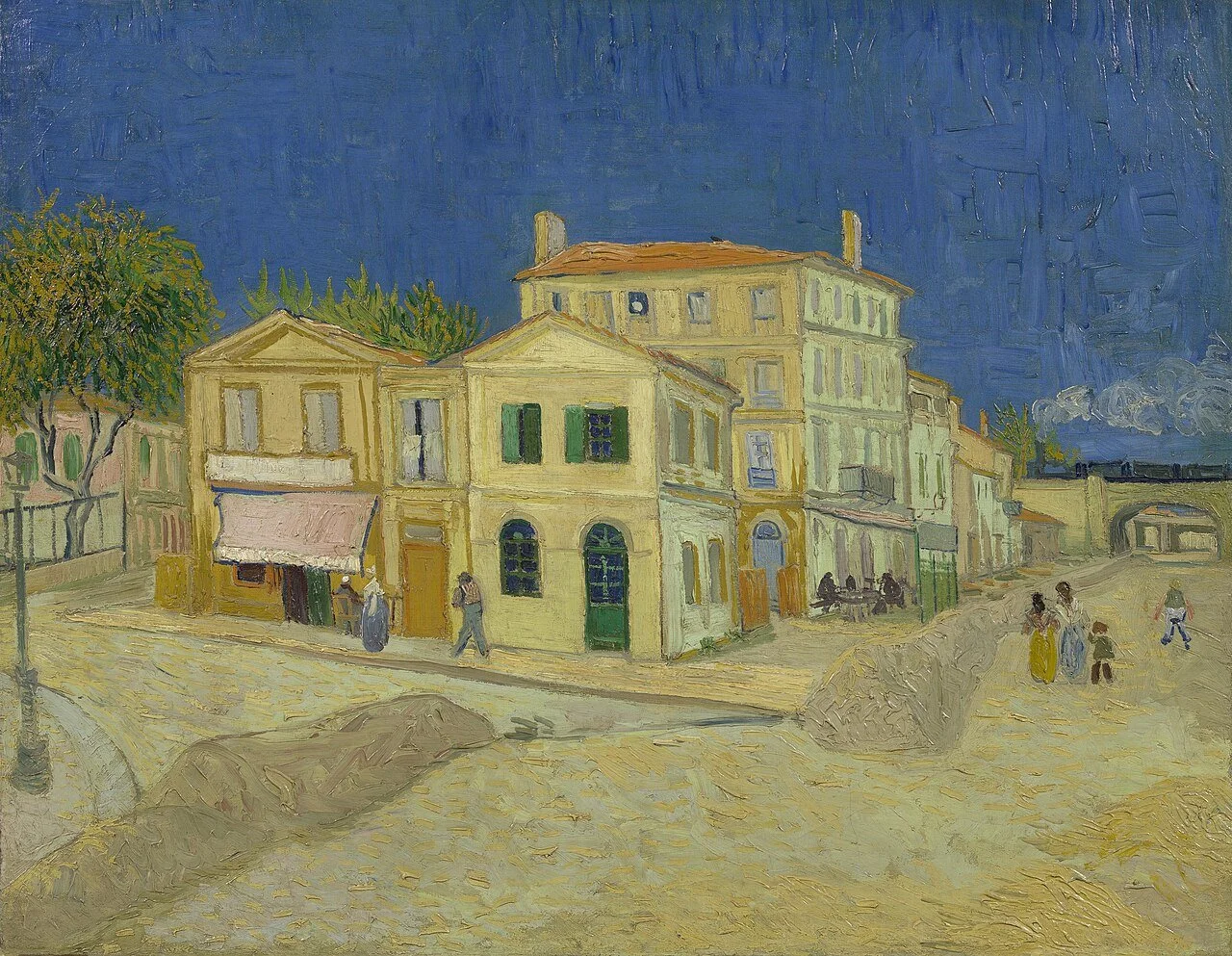
By Vincent van Gogh - Van Gogh Museum, Public Domain, https://commons.wikimedia.org/w/index.php?curid=38583612
He idolized Paul Gauguin. Gauguin did not return the feeling. He was scared of Van Gogh because of his extreme reactions. But Van Gogh persuaded him to come to the Yellow House and live with him. It did not go well. Gauguin left, and Van Gogh had a breakdown, which included punishing himself for causing Gauguin to leave by cutting off most of one ear. “It wasn’t just the end of a friendship he so earnestly prized; it was also the end of his dream for the Yellow House.” ~Page 129
I highly recommend this book, and Ramsey’s other book, Rembrandt in the Wind. He’s not an art scholar. He writes like the farmer-pastor-storyteller he is. Well written, easy to read, you learn things, and find lots to think about.