Michelangelo’s Pietà
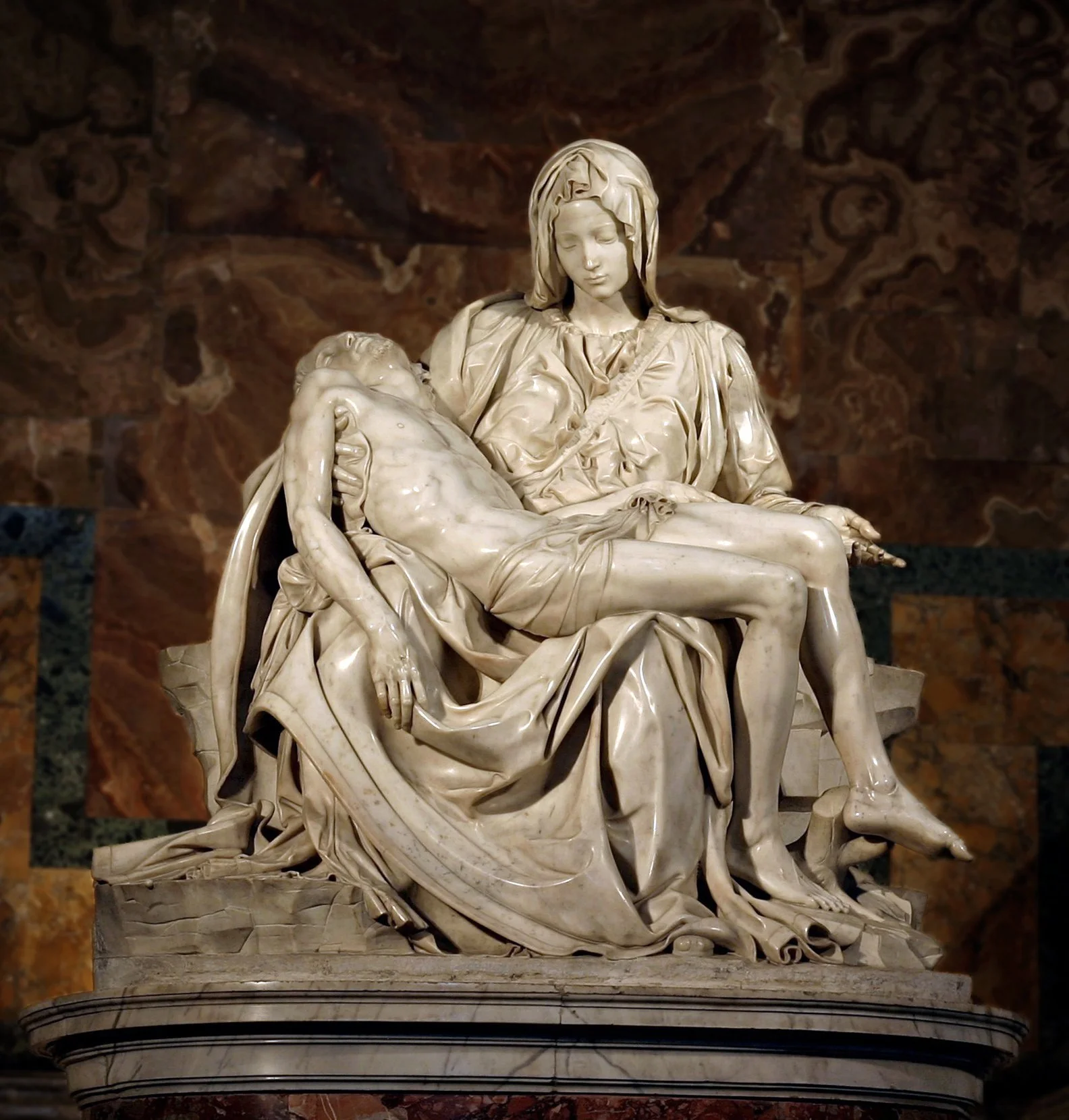
By original file by Stanislav Traykov - File:Michelangelo's Pieta 5450 cropncleaned edit-2.jpg, CC BY 2.5, https://commons.wikimedia.org/w/index.php?curid=9098900
In preparation for our trip to Italy, I checked out the book The Agony and the Ecstasy: A Biographical Novel of Michelangelo by Irving Stone. I didn’t read the whole thing, but I collected some quotes about the Pietà. That is one of the most important things I hope to see in Italy.
Later, Joseph of Arimathea asked Pilate for the body of Jesus. Now Joseph was a disciple of Jesus, but secretly because he feared the Jewish leaders. With Pilate’s permission, he came and took the body away. He was accompanied by Nicodemus, the man who earlier had visited Jesus at night. Nicodemus brought a mixture of myrrh and aloes, about seventy-five pounds. Taking Jesus’ body, the two of them wrapped it, with the spices, in strips of linen. This was in accordance with Jewish burial customs. ~John 19:38-40
The true serge had to be inside the marble itself. Drawing and models were his thinking. Carving was action. ~Page 343
Now he had to plunge in boldly to find his principal features. The weight of the material of the Madonna’s head covering, forcing her head downward to the innerhand of Christ that crossed her heart, compelled attention to the body stretched across her lap. The tight band which ran between the Virgin’s breasts was like a tight band constrictingn and crushing a palpitating heart. The lines of the drapery led to the Madonna’s hand, with which she held her son, securely, under his arm, then to the human aspects of Christ’s body, to his face, the eyes closed serenely in deep sleep, the nose straight but full, the skin clear and firm, the soft mustache and delicate curling chin whiskers, the mouth filled with anguish.
Because the Madona was gazing down on her son, all who looked must turn to her face, to see the sadness, the compassion for all men’s sons, asking with tender despair: “What could I have done to save him?” And from the depth of her love, “What purpose has all this served, if the man cannot be saved?”
All who saw would feel how insupportably heavy was her son’s dead body on her lap, how much heavier was the burden in her heart. ~Pages 345-346
…It was Michelangelo’s desire to blend the classical Greek concept of the beauty of the human body with the Christian ideal of the immortality of the human soul… Human beauty could reveal sacredness as clearly as could pain. At the same time, it could exalt. ~Page 346
He would not sculpture agony. The nail holes in Christ’s hands and feet were tiny dots. There was no sign of violence. Jesus slept peacefully in his mother’s arms. Over the two figures there was a suffusion, a liminosity. His Christ awakened the deepest sympathy, not abhorrence for those who stood outside the sculpture and had been responsible.
His religious faith he projected in terms of the sublimity of the figures; the harmony between them was his way of portraying the harmony of God’s universe. He did not attempt to make Christ divine, since he would not have known how, but exquisitely human. The Virgin’s head emerged delicate, the features Florentine, the face of a maiden with silent pale composure. In her expression he made a distinction between divine and sublime: sublime, for him, meant supreme and perfect. He reflected, “The meaning of the figures lies in their human qualities; the beauty of face and form portrays the grandeur of their spirit.” ~Page 355-356
As he [Michelangelo] reached the door of the chapel and turned back for a last look, he saw that the Virgin, too, was sad and lonely; the most alone human beigh God ever set on earth. ~Page 359
Even without having seen the real sculpture, Michelangelo’s Pietà has been a holy and significant image for me. I have had many imaginative experiences with the mother of Jesus holding the dead body of her son Jesus.
Friends who have seen the sculpture told me it is behind glass and not as easy to see and experience as it used to be. I am not surprised. I hope that being in the presence of the marble Michelangelo sculpted will still be a moving experience for me.
Good article
The Pieta: A Story in Five Parts by Debra Brehmer, Portrait Society, Gallery of Contemporary Art.