Pachinko by Min Jin Lee
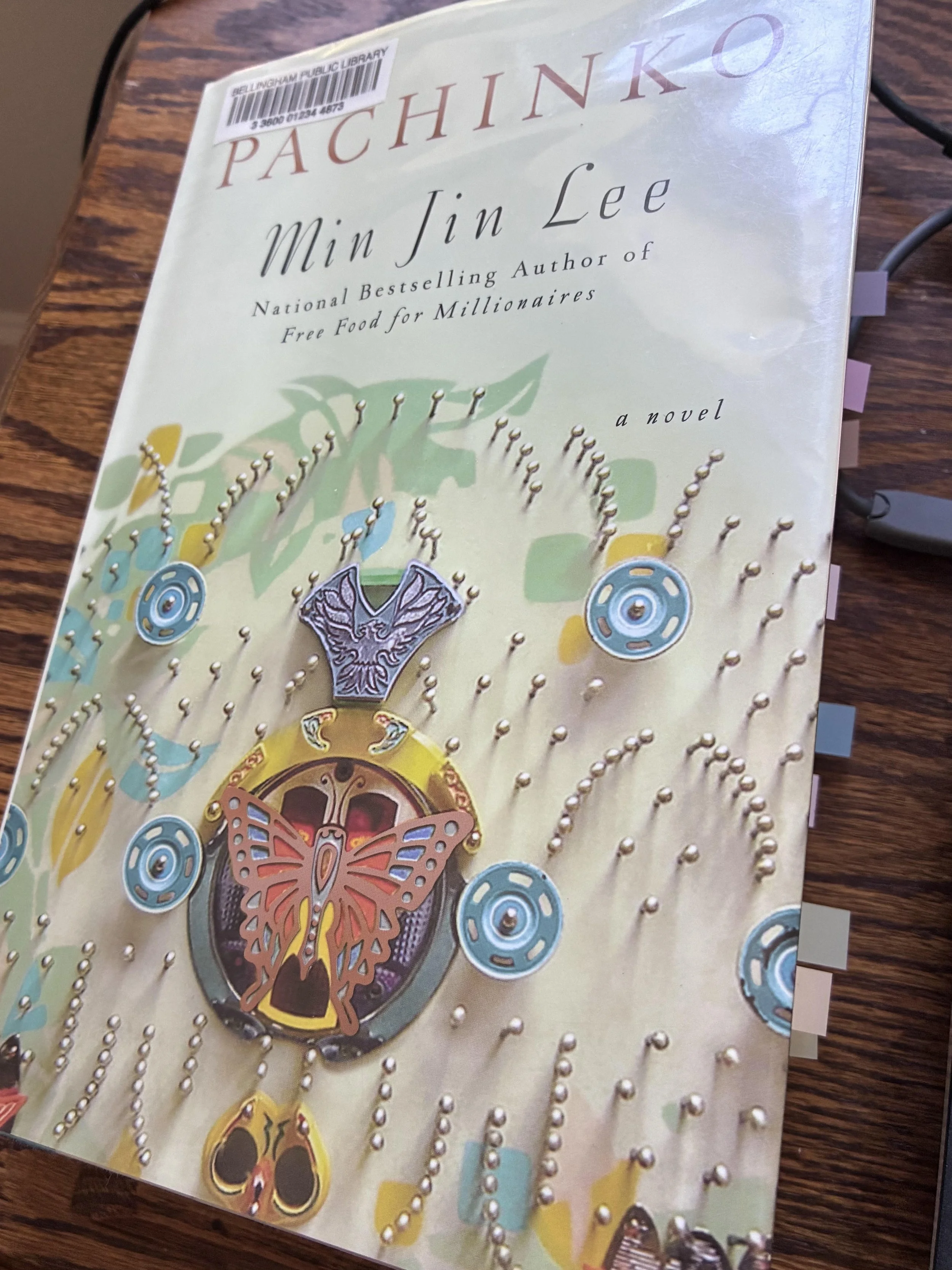
Pachinko - 5*
Min Jin Lee
Good book!! When the game Pachinko was not even mentioned for the first half of the book, I wondered why Min Jin Lee titled it Pachinko. One of the reviews I read said it was because Pachinko (the game) reflects a theme throughout the book — the way our lives are subject to chance, over which we have no control.
Pachinko is often described as “Japanese pinball.” We had a Pachinko game in our garage for many years. I was clueless on how it’s supposed to work, but it was fun to watch all the little balls bouncing around and down the pins. In the book, one of the characters who runs a Pachinko parlor taps the pins in the early morning before it opened:
Goro would gently tap a few straight pins on the vertical pachinko machines with his tiny rubber-coated hammer. He was tapping the pins very, very slightly to alter the course of the metal balls to affect the machine’s payout…Goro…had a kind of touch—a true feel for the pins.
Pachinko tells the story of several generations of a Korean family living in Japan. The Japanese look down on Koreans, treating them as foreigners even when they have lived in Japan for many years and generations. Koreans have a hard time finding good work because the Japanese tend not to hire them. Things have improved now since the times depicted in Pachinko, but the Koreans in Japan still face discrimination.
In the Acknowledgments section of the book, Lee writes about the many years she spent trying to write the story of Koreans in Japan. She researched extensively and wrote some short stories.
Then in 2007, my husband got a job offer in Tokyo, and we moved there in August. On the ground, I had the chance to interview dozens of Koreans in Japan and learned I’d gotten the story wrong. The Korean Japanese may have been historical victims, but when I met them in person, none of them were as simple as that. I was so humbled by the breadth and complexity of the people I met in Japan that I put aside my old draft and started to write and revise it until its publication [2017]. ~Page 487
The story starts in a village in Korea. A married couple take in lodgers to make enough money to live. They have one surviving son, Hoonie, who was born with a cleft palate and a club foot. His deformity made it hard for Hoonie to marry.
It was unthinkable that a decent family would let their daughter marry someone with deformities, since such things were inevitable in the next generation. ~Page 7
However, a matchmaker found a young girl whose father was poor and desperate to find husbands for his four daughters. Hoonie and Yangjin had one surviving child, a daughter named Sunja. After Hoonie’s death, Sunja and her mother continued to earn their keep by taking in lodgers. Sunja fell in love with a rich merchant, Hansu, who turned out to be already married with children. Sunja did not know this until she had become pregnant. She would not consent to being a mistress to Hansu. A lodger who came through, a Korean, Baek Isak, on his way to be a Christian missionary to Japan, agreed to marry her and take on the child as his own.
Thus began the saga of Sunja, Isak, Hansu, and their two sons, Noa and Mozasu. Sunja and Isak went to Japan and started their life together there. The book is a big one, which I love when it’s as good as this one. The story spans the years from 1910 to 1989. This includes Japan annexing Korea, both World Wars, the Korean War, and Vietnam. The characters do not directly participate in these world events, but their lives are greatly affected by them.
I liked the way Lee depicted Christians in the story. The book was not at all about Christianity, but Isak is a Presbyterian missionary, and Sunja adopts his faith. Both of them try to follow what they were taught about being followers of Jesu Kirisuto. They are kind and do everything they can to take care of each other and their family. They are very poor and struggle to have enough to eat or a decent place to live. Hansu, as a rich merchant, ends up helping them financially even though Sunja would prefer not to have him in her life.
Hansu and Sunja’s son Noa grows up to be an excellent scholar. Isak and Sunja’s son, Mozasu, does not like school and ends up working in a Pachinko parlor, and eventually becomes a successful Pachinko parlor owner himself. The story is so rich with characters, landscapes, homes, the effects of organized crime called the Yakuza, love, injustice, luck, life, and death that I cannot figure out what more to write. I encourage you to read it!