Rebecca Sue: A Sister's Reflections on Disability, Faith, and Love by Kathleen Norris
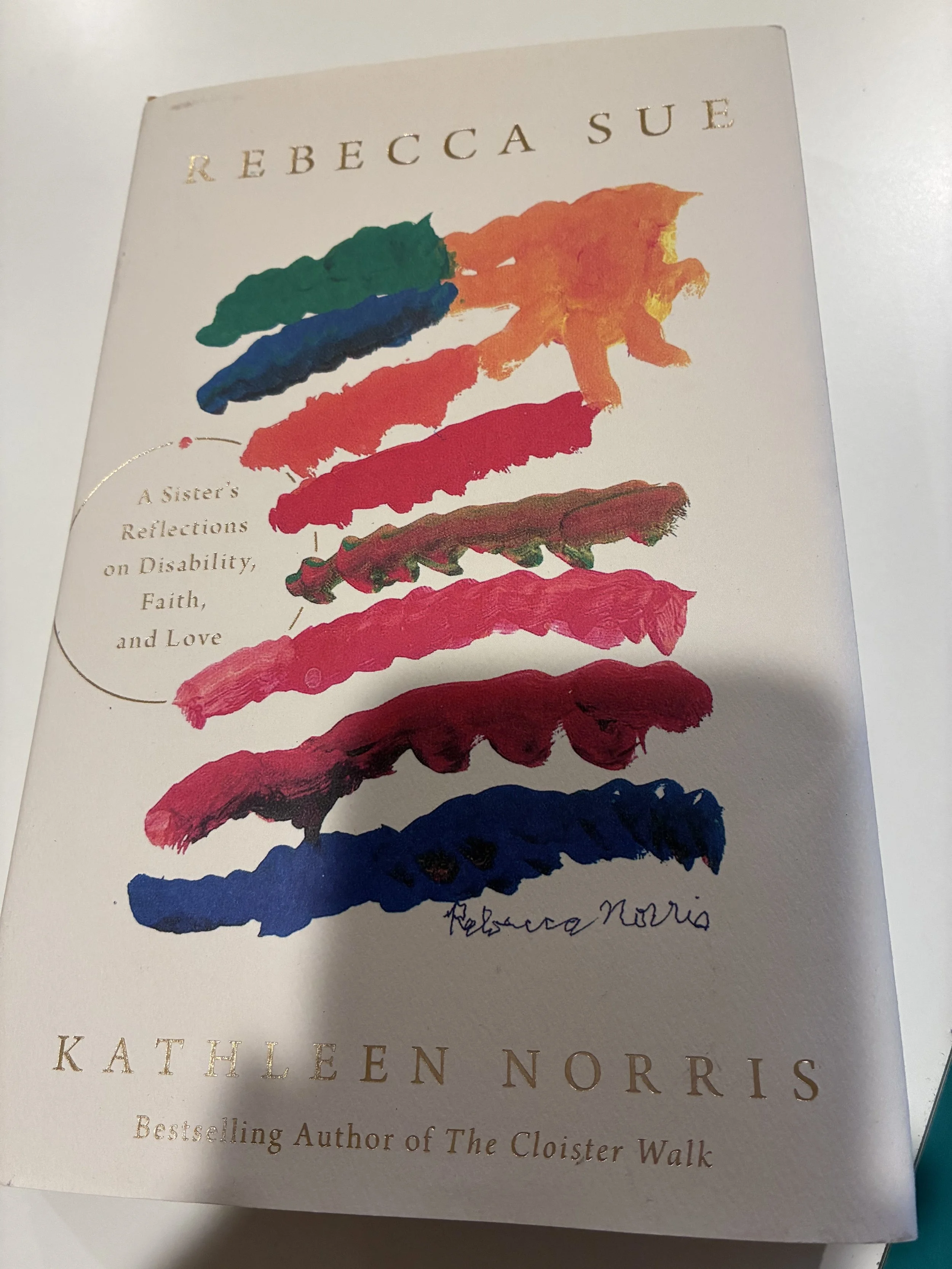
Rebecca Sue: A Sister's Reflections on Disability, Faith, and Love - 5*
Kathleen Norris
I knew I would like Kathleen Norris’ latest book, Rebecca Sue, because I'd enjoyed several of her previous books, including Dakota, Cloister Walk, and Acedia & Me. Rebecca Sue is the name of Norris’ sister. She was brain-damaged at birth due to being deprived of oxygen during labor. This resulted in both physical and mental disabilities that made life difficult for her and those who cared for her. Norris’ parents were loving and people of faith, and they, along with Rebecca Sue’s siblings, surrounded Becky with love. They took her to many doctors and specialists, enrolled her in multiple programs, enlisted the help of many people who gave her safe places to live, and helped her find and keep jobs.
Norris used Becky’s letters to help tell her story. She kept Becky’s spellings and writing mistakes. I felt I was getting to know Becky personally. Norris found a list her parents had made of questions that Becky asked in her letters to them. The book was framed in parts based on some of those questions and other quotes:
Will I Always Be Slow?
How Do You know When You’re in Love?
What Can I Do to Be Good Enough to Develop Skills?
What Does ‘Being Dependent’ Mean?
What Will Happen to Me If You, Dad and Mom, Get Sick?
It’s Important to Be the Right Kind of Person.
Here We Go Again.
I Bet I Can Have Dessert Now
You can tell from these headings how desperately Becky wanted to be good, do well, experience love, and understand herself. Her limitations made that hard and frustrating. She lashed out at her caretakers in that frustration and behaved in inappropriate and harmful ways. Yet she also was loving and kind. Over the years, she was medicated for many mental health issues such as manic depression, bipolar disorder, and more. She also tended to get illnesses such as pneumonia and UTIs.
Norris describes Becky’s life with 2-3 page essays, like a journal. One of the entries is titled, “You can’t hit me, I’m retarded!”
Becky discovered that this line doesn’t work with sisters, especially one who has witnessed you writing on a cement-block wall with her first lipstick…
Growing up with Becky, it was always a challenge to distinguish between what she needed to be held accountable for and what she couldn’t help due to her disability. ~page 22
Heartbreakingly, Becky earnestly wanted a lover and husband but never found one. Her desire combined with her limitations caused men to take advantage of her, and she was sexually molested more than once. Those traumatic experiences caused even more suffering.
Kathleen Norris and Becky both saw that the two of them were alike in many ways. Norris came to believe that if Becky had not been brain-damaged at birth, she would have become a writer, too.
[From one of Becky’s letters:] I daydream an awful lot like I picture how things will be better for me like when a boy asks me to go out with him and after a while we are going together and his friends are jealous of me. Also he will say I am cute and hopes I am not going with anybody. But I been doing an awful lot of thinking about me—no matter how such I change myself I still do a lot of my old ways. ~page 49
I thought of Flowers for Algernon as I read this book. In that science fiction story, a mentally challenged man receives a drug that expands his intellect. He becomes smarter than the scientists running the experiment. But after time, the drug loses its effect. The man goes back to the mentally challenged person he had been. One of the tragic things about that was the man knew his loss of intelligence was going to happen. Imagine knowing that you would lose your intellect and become a different person. Alzheimer’s has that kind of phenomenon, too. Becky knew that she had been brain-damaged when she was born. She was angry that had happened to her. She mourned what she might have been.
Over the years, Norris often watched movies with Becky. It was a good way to spend time together without conflict or bitter reactions from Becky. Norris would let Becky pick which movies to watch. That meant she had to sit through some pretty bad ones, but they also saw many good movies. Now Norris co-writes a Substack about movies called Soul Telegram. I wonder if her interest in movies developed from watching them with Becky.
I highly recommend Rebecca Sue. It is not long, easy to read, and well written. You will enjoy getting to know both Kathleen Norris and Becky. You will also gain insight into what it’s like to care for and live with someone with mental illness and other limitations. Right up to Becky’s death, there were good, calm times, sad times, frustrations, and uncertainty. Love was consistent, but nothing else. That love — for each other and for God — permeates the story and makes it a hopeful one.