Books I Read in 2026

from ggprints on Etsy
* = Stars (rating)
#1 - James: A Novel - 5*
Percival Everett
James is a great book. Great writing, incredible creativity to imagine the story of Huck Finn from Jim’s perspective, wonderful writing. As I read it, I felt immersed in James’ world. For me, that was a problem. I felt so immersed in it, empathized so deeply with the trapped, beaten, unfair, horrific world James lived in, that about halfway through I could not read on. I found this detailed summary of each chapter, and then skimmed the last part of the book. I cannot watch movies or shows where people are in prison for the same reason. My stomach gets tighter and tighter, my heart beats faster, and I have difficulty getting through the stressful feelings in my body and soul. Whether it’s trapped in prison or trapped in slavery, it has the same effect on me.
One of the first things I observed about the story was the way James spoke “slavery language” around white people and normal, quite educated English around fellow slaves/black people. At first, I was distracted by wondering if that actually happened. But soon I just marveled in the imagination of it, and enjoyed watching it play out.
Some quite harsh anti-Christianity/anti-religion comes out in the character of James.
…the Bible itself was the least interesting of all. I could not enter it, did not want to enter it, and then understood that I recognized it as a tool of my enemy. (page 90)
I am always interested in what people think and say against the faith I love. It helps me understand their reasoning, and wonder how I can try to ensure I do not foster the evil they see by what I say and do. James does not explicitly give details on his view of Christianity. I can imagine, though, the Christian people who defend slavery using the words of the Bible, the cruelty and injustice practiced and justified by Christians must contribute to his opposition.
The reviews often write about the “humor and horror” of the story. I have to admit I didn’t laugh out loud or consciously think something was funny. Characters said or did absurd things that were humorous. Mostly, I felt the horror part.
I am struggling with how to encourage people to read the book. I mentioned I have a hard time watching prison movies because my body responds so viscerally. Have you seen “The Shawshank Redemption?” It’s a great movie. I highly recommend it. Yet, I had a hard time watching it. That gut reaction happened. I had to wait until I felt psychologically strong enough to handle it, and purposely watched it on a TV to counteract the overwhelm of a big screen. That feeling of liking and highly recommending James is the same for me as liking and highly recommending James. Try it.
#2 - Glimmerings | Letters on Faith Between a Poet and a Theologian - 5*
Miroslav Volf & Christian Wiman
I've read a lot of Christian Wiman and heard him at the Festival, but I haven't read anything by Miroslav Volf, though I have heard of him. They're both Yale professors. It was a very good book. Deep. What Titanic minds those two are. They usually take walks around Yale together, but this book is a collection of letters they wrote to each other while Wiman was undergoing cancer treatment. He's had cancer multiple times and has been close to death several times.
There were lots of gems:
MV: I am saved by God’s faithfulness, not primarily by my faith. (page 4)
I always feel befuddled when Jesus says, after performing a miracle, “Your faith has made you whole.”
CW: I find it very consoling to think of my faith not mattering so much, of it being mostly a form of patience.”
He writes about having a hunger, “a restless and appetitive drive” for faith of two types, a good hunger and a bad one:
CW: The former [the good hunger] lives with no expectation of permanent fulfillment. “Glimmerings are what the soul’s composed of,” as Seamus Heaney puts it in “Old Pewter.” One gathers one’s soul, one’s god, fitfully, fugitively, and is content with that.” (page 7)
Hence the book title. :) It reminds me of Parker Palmer’s description of seeing glimpses of God, or hope, or something like that when he was clinically depressed, immobile with depression. He describes seeing a kind of wild creature hidden in the forest, glimpsing it only briefly now and then.
MV: I am less reaching for God than recognizing, at times, that God is holding me. (page 10)
I love this way of expressing the feeling I have that there is a bedrock, a foundation, within me of God’s love and my trust in it, even when I may not recognize or feel it.
MV: My love can be love only to the extent that it participates in God’s love, or, rather, to the extent that God is doing the loving through me. (page 13)
Oh. May God love through me.
MV: Our lives are not in our control, and whoever controls them rarely seems to have our best interests in mind…
I trust God even when God isn’t doing what seems reasonable to think that God should do…Hope is trust on tiptoes, said Charlie Moule, a Cambridge New Testament scholar…
[H]ope isn’t a reasonable expectation that some determinate positive goal, the hope’s object, will become reality. Instead,…hope is a way of living into the future with objects or expectation themselves only vaguely and tentatiely known. And lightly held, too, with a readiness to recognize as the hope’s fulfillment even things that weren’t explicit in expectation…
Hope, [Luther] writes, transfers a person ”into the unknown, the hidden, and the dark shadow, so that he does not even know what he hopes for.” And then, miracle of miracles, in the arrival of that which was beforehand not known or not fully known, I recognize with joy the object of my hope!
Christ…both fulfilled and transformed hopes. (pages 103-104)
“Hope is trust on tiptoes.” OMG.
And, “miracle of miracles,…I recognize with joy the object of my hope!”
Hope, glorious hope!!!
These are only a few gems in the first third of the book. I think I need to read and re-read it many times.

I love this picture from Christianity Today of Christian Wiman and Miroslav Volf. It envisions what I see when I think “Titanic minds,” which is what came to me over and over as I read this book.
#3 - Inhabit the Poem | Last Essays - 5*
Helen Vendler
My fascination with poetry is pretty recent. I’ve often thought it would be fun to take a class on poetry. Poetry Unbound with Padraig O’Tuama feels a little like a class—he reads a poem, reflects on it, then reads it again. It’s awesome. I read or heard someone talking about this book by Helen Vendler, and it sounded like a class, another way to learn about poems and poetry, that would be more scholarly. She wrote all the essays—an essay for each poem—in her last 3 years of life, and wrote the introduction 3 days before she died. They truly are her “last essays,” as the subtitle says. The introduction ends with:
For each of these poems, I hope to cast light on its imaginative originality, its escapes from cliche, intellectual mediocrity, and linguistic intertia; and its ambitious adventures in linguistic play as it searches out, for its own era, the passionate and permanent feelings of the human race.
Doesn’t that sound fascinating? Ha-ha. I know it does not to many of you, but it did to me.
In the first essay (the first chapter), I already dog-eared a bunch of pages and underlined all over the place. So rich with understanding. The first poem she writes about is The Second Coming by W.B. Yeats. The last two lines very likely sound familiar to you:
And what rough beast, its hour come round at last,
Slouches towards Bethlehem to be born?
I associated the phrase “Slouches towards Bethlehem” with Joan Didion. She wrote a book titled Slouching Towards Bethlehem, which I have heard of but never read, and I had no idea where the phrase came from. It was so interesting to learn that Yeats was writing about the second coming, describing it like:
A shape with a lion body and the head of a man,
A gaze blank and pitiless as the sun,
Is moving its slow thighs…
It was this beast that was slouching towards Bethlehem. What a strange, intriguing way to describe the second coming of Christ.
I know we enjoy poetry for many reasons—the sound of the words, the look of it on the page, the associations it brings to mind, the feel of it on our tongue, the way it makes us feel, and so on. I am grateful to have learned that we do not have to analyze the poem like a puzzle to find out what it means or what the poet is trying to say. Not being able to “figure out” poems took away my enjoyment of them. But it adds to my enjoyment to learn allusions and references I missed. That’s what these essays gave me—insights into those allusions and references, understanding of the various forms the poets were using (sonnets, blank verse, couplets, rhyme, lyric poems, etc.), and why the poet may have made the decisions he/she did.
If you have the slightest interest in learning and understanding more about poetry, this is a great book to pursue that.
#4 - Indivisible - 4*
Fanny Howe
In “The Tune of Things” in Harper Magazine, Christian Wiman says, “I can’t overstate how important a presence [Fanny Howe has] been in my life, though we’ve probably spent a total of fifty hours together.” He calls Indivisible her masterpiece. Well, I think Christian Wiman is a marvel. He’s one of my heroes, as I call people whom I admire to the utmost. So, I got Indivisible and read it—most of it. I didn’t have the patience to keep reading. I got confused a lot; I would have to go back to previous pages to figure out who or what they were talking about. I’m sure it’s a failure of my ability to focus. I wish I could take a class from Christian Wiman about this book. He did write a review of it, but it’s in the Wall Street Journal behind a paywall.
I read other things about her, such as “Dear Fanny, Don’t Worry I Know You’re Dead” in Literary Hub by Ezra Fox, and a book of her poems, Second Childhood (#40 in my list of “Books I Read in 2025”). In Indivisible and the other things I read, I saw and admired her writing. I may come back to the book at some point, and I will read more of her writing wherever I see it.
#5 - Solito | A Memoir
Javier Zamora
Incredible story! Javier Zamora, nine years old, goes from El Salvador to the US. I loved this book! I just now googled to find out what the title means. Solito means Alone. At first, I was surprised by the title, since Javier is not alone. He is “adopted” by Patricia, Carla, and Chino, all of whom are on the trip with him. Patricia and Carla are mother and daughter, on their way to join their husband/father and younger daughter/sister in Virginia. Chino is a nineteen-year-old boy/man, unrelated to them, but they become a family.
Chino poses as the husband and dad, even though at nineteen, he is quite a bit younger than Patricia. Javier writes that Chino looks older and Patricia looks younger, and it works. They all take on names and have papers, making them into a family. The love they show for each other fills my heart. In the long, long walk, Chino carries Javier, the youngest, who cannot even tie his shoes yet. They share their water, their “beds”—mattresses on the floor, or the floor itself, or the desert dirt—, their scant food, everything.
The book is written from the nine-year-old’s perspective. He doesn’t understand English. Often, sentences, passages, or words are written in Spanish. It reminded me of the way some of Georgette Heyer’s novels have French in them, untranslated. As when I read those, I did not stop to look up the words. I was able to get the gist, or enough of it, by the context. Javier is a poet, too, and I thought even at nine he was showing a love of language. He named the cacti and bushes he saw, even the lizards. He called the cacti “the Spikeys,” “Cheerleader bush,” with flowers like pom-poms, “Crayon bush,” “Paint-Roller Fuzzies,” “Mascara Brush Fuzzies,” and “skinny green smooth tree,” which he abbreviates to “SGS tree.” A blogger who calls him/herself “The Time Traveler” describes these and many other things wonderfully in the entry titled “Javier Zamora’s Solito: A Memoir Like No Other.”
Immigration, and especially what is called “illegal” immigration is a huge topic right now. This book does not talk about the topic at all. It is just a detailed description of Javier Zamora’s trip. It is heartwarming, harrowing, beautiful, sorrowful, full of yearning, hope, disappointment, and love.
#6 - The Briar Club - 5*
Kate Quinn
If I’d have read that The Briar Club was a historical fiction novel, I might not have even picked it up. I often do not like historical fiction. To me, some of them are sentimental or “gushy,” portraying the historical person(s) as unrealistically heroic. There is a word for a biopic that does that—makes the celebrity practically a god—but I cannot think of the word or find it. Anyway, The Briar Club did not strike me that way, thankfully!
The book is about a boarding house in Washington, DC, and the people living there. It is set during the McCarthy era. There are historical figures and events spoken of: McCarthy, the president, the Korean War/Military Action, the women’s baseball league, and others. I did not recognize any of the characters as a real person, but there are some reviews that claim the characters are based on real people.
I enjoyed the book. It begins kind of strangely, with the house itself talking. I liked it, though. It was fun to imagine the house observing everything going on and wishing for certain outcomes, enjoying some things and not others.
The main character is Grace March, the “lovely, mysterious widow” (from the book flap) who moves into the attic room. Each chapter, though, is narrated by a different character, including the house itself. It starts with a murdered body being found, and as you read, you find out what happened that led up to the murder. Each of the characters is interesting. It is fun to read the thoughts, motives, and actions of:
poised English beauty Fliss, whose facade of perfect wife and mother covers gaping inner wounds; policeman’s daughter Nora, who finds herself entangled with a shadowy gangster; frustrated baseball star Bea, whose career has come to an end along with the women’s baseball league of World War II; and poisonous, gung-ho Arlene, who has thrown herself into McCarthy’s Red Scare. (book flap)
As the chapters unravel what happened, you get to know each person, and understand how they became a part of the murder mystery. For a little extra fun, there’s a recipe for each chapter and each person. Food is a central player. When Grace moves in, she starts inviting everyone to have dinner together once a week, with alternating persons cooking. The house is rather bleak, and the boarders keep themselves to themselves, mostly thanks to the owner of the house, a bitter, stingy widow with two young children. Grace’s dinners happen while she is at her weekly bridge game. Not only do friendships grow, but the house becomes a nicer place to live as Grace begins painting the walls of her room with flowers, and others join in.
I cannot remember reading anything else set in the McCarthy era, and it was intriguing to see the effect of the Red Scare. I heard of it in history classes, but it made it more real to get to know people living in it and affected by it. As I think back on the book, I realize, too, that Quinn did a good job of making it feel true to the time. Sometimes books (or movies) bring in sentiments or words that make me wonder, “Did people really feel that way back then? Or say that?” I never thought that once while reading this book.
No one knows who Grace really is. That is a mystery until the end, just like the murder. I did not figure it out and enjoyed the revelation.
I recommend The Briar Club!
#7 - Forgive Everyone Everything - 5*
Gregory Boyle
I couldn’t find a review of this book to link to that said something I always tell people when I speak of Father Greg Boyle—he is funny! Forgive Everyone Everything is a collection of 52 of Father Greg’s stories from his various books, compiled into a weekly devotional. I like it so much, I am planning to buy a copy for each of my kids. The stories are short, easy to read, touching, often funny, and give you pause.
I have written about Father Boyle many times (Google "Boyle” on my blog—https://www.mavismoon.com/search?q=Boyle—, and you’ll see!). He is one of my heroes. I have heard him speak several times at the Jesuit Retreat Center in Los Altos, which I often go to. He is a Jesuit himself and has a special relationship with the retreat center. When he speaks there, and nearly everywhere he speaks, he brings two of the “homeboys” from the Homeboy Institute he founded in Los Angeles. One of the things I often remember is what he said about “making good choices.” He said people often talk about needing to help others make good choices. But the thing is, these homeboys (and girls) have no choices to make. They are often trapped and have no choice.
Father Boyle began ministering to LA gang members in the ‘80s. They first tried mediation, but they realized that it was not working. Then they thought the best way to help would be to find jobs for the guys. That was effective, and eventually, with support and funding, Homeboy Industries was formed. They provide many services, both to men and women—not just jobs (where gang members often work side-by-side with rival members), but also housing, education, tattoo removal, counseling, and more.
Often, the humor in Father Greg’s stories comes from the homies’ unique use of words. Here are a few samples of his writing from Forgive Everybody Everything.
I asked Horacio if he had ditched school that day. “Noooo,” he said, “we didn’t ditch school—we just didn’t go.” My apologies. (page 4)
[From a homie who texts him up to 4 times a day.] “I’m fond of you,” he texts me once, from left field. I write back, “Well…I’m fond of you, too—and I’m grateful to God that you’re in my life.” His response is immediate: “The feeling is neutral.” I’ll take it. (page 40)
You can’t tell Rascal anything—except this one day, he actually listens. I am going on about something—I can’t remember what but I can see he’s listening. When I’m done, he says simply, “You know, I’m gonna take that advice, and I’m gonna let it marinate,” pointing at his heart, “right here.” (page 45)
Here is an entry called “Masterpieces.”
Anthony is in his mid-thirties and in his tenth month as a trainee at Homeboy Industries. He and his wife have three very young daughters. He was mainly missing in action for the birth of his first two. When the third is born, he holds her in his arms and tells me later, “Damn, G…I looked at her face and I thought, ‘She looks exactly like her mother—angry.’” We laugh.
Half of Anthony’s life had been spent in jails and detention facilities. Before coming to us, a meth addiction crippled him surely as much as his earlier gan allegiance did. We’re speaking in my office one day and he tells me that he and his twin brother, at nine years old, were taken from their parents and a house filled with violence and abuse and sent to live with their grandmother. “She was the meanest human being I’ve ever known,” Anthony says. Every day after school, every weekend, and all summer long, for the entire year Anthony and his twin lived with her (until they ran away), they were forced to strip down to their chonies, sit in this lonely hallway “Indian style,” and not move. “She would put duct tape over our mouths…cuz…she said, ‘I hate the sound of your voices.’” Then Anthony quakes as the emotion of this memory reverberates.
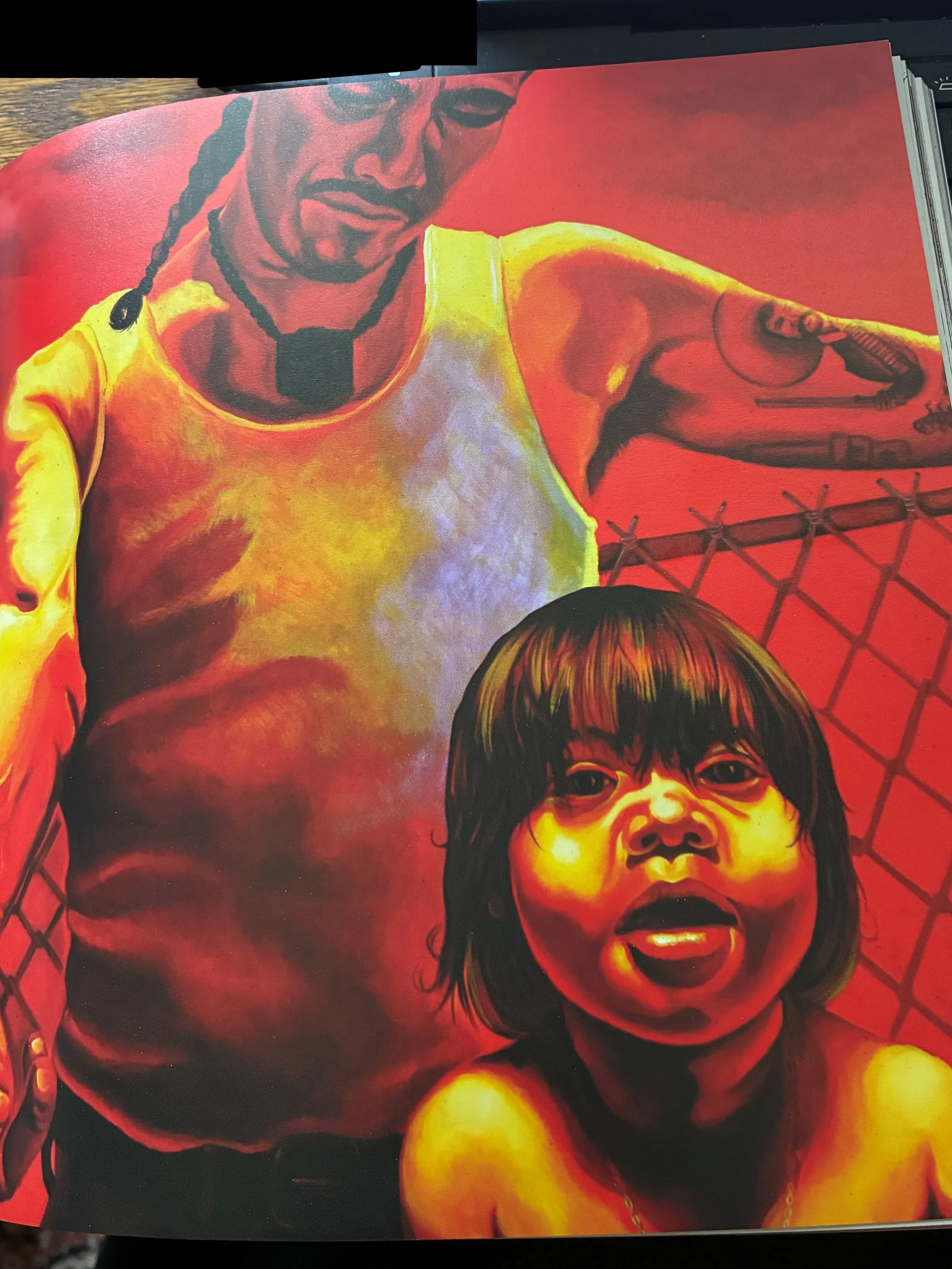
by Fabian Debora, the Executive Director Homeboy Art Academy. Page 19, Forgive Everybody Everything.
“This is why,” he says, holding a finger to his mouth, “I never shush my girls.” He pauses and restores what he needs to continue. “I love the sound…of their voices. In fact, when the oldest one grabs a crayon and draws wildly on the living room wall and my wife says, ‘DO something! Aren’t ya gonna TELL her something?’ I crouch down, put my arm around my daughter, and the two of us stare at the wall, my cheek resting on hers, and I point and say, ‘Now that’s the most magnificent work of art…I have ever seen.’”
Here is the Good News: The God we most deeply want IS the God we actually have, and the god we fear is, in fact, the partial god we’ve settled for. Good looks at us and is ecstatic. This God loves the sound of our voices and thinks all of us are a magnificent work of art. “You’re here.” God’s cheek resting on ours. God’s singular agenda item. (page 25)
The book is also illustrated with awesome art by Fabian Debora, the Executive Director Homeboy Art Academy.
#8 - We Are All Completely Beside Ourselves -5*
Karen Joy Fowler
What a good book! As the author writes, it begins in the middle. This is a novel, written as if it were a memoir. Rosemary, the “memoirist” and narrator, begins the story of herself, her brother, sister, mother, and father in 1996, when “ten years had passed since I’d last seen my brother, seventeen since my sister disappeared.” (page 5)
Have you heard the term "unreliable narrator"? I thought of that while reading this book, especially in the first half. Rosemary gives her life story to various others in her life, and that is how you think you are learning her story. But, in some cases, afterward she’ll write something like:
That story I told Harlow—that story in which I’m sent to my grandparents in Indianapolis—obviously that story isn’t really from the middle of this story. I did tell it to Harlow just when I said, so my telling of it is from the middle, but the happening and the telling are very different things. This doesn’t mean that the story isn’t true, only that I honestly don’t know anymore if I really remember it or only remember how to tell it. (page 48)
Okay…not obvious to me. She goes on to say that “an oft-told story is like a photograph,” which I get. It is true that sometimes I am not sure whether my memory is real or based on photos. There are even memories I am not sure whether they happened or were a dream, especially from when I was very young. But, I guess, at least for me, that doesn’t happen—as far as I know—with something as significant as whether I went to my grandparents’ home or not, for example. Anyway, I started reading the narration with a grain of salt, waiting to see whether she would reveal its veracity. (Although, of course, it is fiction, so not literally the truth, but you know what I mean. True for this story.)
Every so often, I appreciated her dry humor and sarcasm, or at least the bordering-on-sarcasm. For example, she wrote an entire paragraph about her father’s theory of child development, drawing on Jean Piaget’s expertise. Then, a few pages later, she described a childhood home and ended with:
My new room may have been bigger than the bright little nook I’d had in the farmhouse, but I could see that the house itself was smaller. Or maybe I coudn’t see that when I was five. Ask Piaget.
I liked her love of TheLord of the Rings, which she referenced as an aside a couple of times. In one case, she found a note from her brother in her copy of Fellowship of the Ring because “He knew I reread that trilogy often; he know that the day would soon come when I’d need the consolation of the Shire.” (page 118) That’s me! As I grew up, I reread The Hobbit and The Lord of the Rings trilogy about every other year. I would think, “I need a visit to Middle Earth.” Another time, she describes a room that had been trashed:
We are Romans amid the ruin of Carthage; Merry and Pippin in Isingard. (page 290)
Cool! Referencing The Lord of the Rings as if it were a classic literary allusion—equivalent to the Roman Empire, maybe even the Bible.
I’m leaving out a key fact (and it is an actual fact in the context of this story) about Rosemary’s sister Fern. If you read the book based on what I’ve written, I think it would be a good experience for you, as it was for me, not to know that key fact until Rosemary reveals it. If I had read the back cover and other reviews, I would have known, but I only skimmed the back cover and missed it. So, finding out about Fern was a surprising twist for me, and I liked it.
I highly recommend We Are All Completely Beside Ourselves. Fun, funny, well-written, quirky but believable characters, twisty plot, intriguing, and thought-provoking. I think you’ll like it.
#9 -The Thorny Grace of It: And Other Essays for Imperfect Catholics - 5*
Brian Doyle
I love Brian Doyle! I have read many of his books and essays, and have marked more in Amazon and the library to read later. I noticed recently, though, that the prices are going up. I think his books are starting to go out of print because he died in 2017. It makes me sad he is gone, but I am thankful he was such a prolific writer during his lifetime.
His writing reminds me of Billy Collins. Their styles are different: Doyle does not write poetry (although sometimes he writes what he calls “proems,” prose that comes close to poetry), but both write with humor and are down-to-earth, straight shooters.
You can see the subtitle on this book says it is “for imperfect Catholics.” I am an imperfect Protestant, and it is for me, too. Doyle was a lifelong Catholic. Isn’t the title good? The Thorny Grace of It. The title essay consists mostly of a list of all the imperfect things (I guess that’s as good a way as any to label them) that made me smile just to read them. Here’s a sample:
The kids are surly and rude and vulgar and selfish and their feet smell so awful your eyes burn if you are trapped in a confined space with their empty sneakers or both of those horrors at once, which happens. Your spouse can be testy and snappish and unfair and inconsistent and obsessed with finances and so liable to mood swings you have more than once considered erecting a barometer in the kitchen…The dog has barfed in every room in the house. The house is mortgaged until the day Jesus Blessed Christ returns in His Radiant Glory to resolve all mortgage payments and carry us home to His house…The rain it does not cease nor does it falter. (pages 115-116)
It goes on from there with galloping hilarity, and heartbreak, too:
My wife and I lost a child, a being unlike any other that ever was or will be, and I will not meet her or him until Jesus Blessed Christ leads me to her or him by the hand and we embrace, weeping. There is so much pain and loss and suffering and fear and helplessness and greed and violence that sometimes I lay abed and feel naught but a great despair, and cannot see how to go on.
Then, the pivot, the turn toward God, like a poem or a psalm:
But then I arise, because I know there are laughter and compassion, and creativity and wonder, and kindness and generosity beyond measure, and I know we are the tools and means by which light pierces the darkness. I know, as well and truly and deeply as I know anything at all, that the thorny grace of it is the shape and nature of its holiness.
How lovely and wonderful is that?
This is only a foretaste of the delight, the tenderness, the joy, and full-heartedness you will receive from these essays.
#10 - The Friday Afternoon Club: A Family Memoir - 5*
Griffin Dunne
Dunne grew up surrounded by Hollywood stars. At first, I wasn’t sure I wanted to read his memoir if it was just going to be name-dropping. But, very quickly, I was laughing out loud and loving it. My husband and I were sitting next to each other as I read, and he said he noticed I kept laughing.
But it wasn’t all funny. Poignant, sad, and tragic things happened, too. The most important one was that Dunne’s sister was strangled to death by her ex-boyfriend. Dunne’s sister, Dominique Dunne, was in several movies and TV shows, becoming well-known. The trial was high-profile, in the news for days.
Dunne is the nephew of Joan Didion. Didion was married to Dunne’s father’s brother, John Dunne. Besides enjoying the many stories and scenes with Hollywood stars such as Harrison Ford, Carrie Fisher, and Janis Joplin, it was interesting to read the interactions with Joan and John.
I wrote a blog about this one.
#11 - The Absolutely True Diary of a Part-Time Indian- 5*
Sherman Alexie
The video I linked to in the title above is a good one for an excellent description of the book and information about Sherman Alexie. Alexie was “cancelled” during the MeToo movement. He admitted that he hurt women. He lost awards and other things of acclaim in the literary world. When all that happened, I had just been to a book reading and signing event for Alexie’s memoir, You Don’t Have to Say You Love Me, which was a very good book. I feel sorry for the men who were canceled, and there are more all the time. It makes me sad, angry, and disappointed all at once. And I definitely have lost trust.
The Absolutely True Diary of a Part-Time Indianis a YA (Young Adult) book. A lot of books labeled YA are awesome! Never let that stop you from reading them. This is what they call a “semi-autobiographical” novel. The main character, Junior, shares many things with Alexie’s life. He was brought up on “the rez.” I follow Alexie’s Substack, and he talks a lot about being a “rez Indian.”
The book is written as if it’s a journal. It includes great drawings, mostly comics. I love them! The labeling is so good and funny.
I wrote a blog about this one.
#12 - American Han - 5*
Lisa Lee
The narrator in this novel is Jane, the daughter of Korean immigrant parents who live in Napa, CA. When the story begins, she, her parents, and her brother are all living in various parts of the Bay Area. Having lived there myself for 45+ years, it was fun to read of familiar places.
A lot of the story hinges on the Korean-American upbringing Jane and her brother Kevin experienced. Near the beginning, Jane is surprised by her mother’s benevolent acceptance of what Jane told her. “I wanted the old mom back. I wanted the old mom so I could tell her that she fucked me up. Then I would be satisfied in hating her.” (page 25) This reminded me of a poem by Philip Larkin that begins with the line “They fuck you up, your mum and dad.”
I wrote a blog about this one.
#13 - Marce Catlett: The Force of a Story: A Port William Novel- 4*
Wendell Berry
William Berry is one of my heroes. He’s 91 years old and wrote a new book. This one is a novel in the Port William series. Port William is a town in Kentucky modeled after the Kentucky town Berry grew up in. There are many books and short stories set in Port William with the same and related characters. I think I’ve read all, or at least most of them. It’s fun to begin reading and find my old friends in Port William again. It’s kind of like The Chronicles of Narnia in that the time will be varied. You may find the book has a character that was a child in the last book you read and is now an old man, or even dead, and the story is about one of his/her descendants. Nearly all the books have a family tree and a map (below) in the endpapers. I love that!
The story begins in 1906 with Wheeler as a child waking up to the sound of his father, Marce, riding his horse to the train station, where he will catch the train to the auction in town, where his tobacco crop for the year will be purchased.
The price paid for each year’s crop has been depressed to virtually nothing by the power of a single buyer, James B. Duke. This year is especially grim since the price offered to each grower is less than the expense of bringing the crop to market. A year’s labor is lost. (front book flap)
It goes on to follow the story of Marce, his descendants, and the land. Like all of Wendell Berry’s books, Marce: The Force of a Story is great. Highly recommend.
I wrote a blog about this one.
#14 -Make Your Home in This Luminous Dark: Mysticism, Art, and the Path of Unknowing - 5*
James K.A. Smith
The concept of a “luminous dark” that Smith writes about, as he names in the subtitle, is the unknown: art, practices, mysticism, and experiences that we cannot fully (or at all) understand. He quotes the naturalist Barry Lopez, then describes what he means by “dark”:
‘I gravitate toward environments of uncertainty,’ Lopez confessed. I understand the allure now. Confusion no longer scares me. Lack of clarity is not a sign of epistemic failure. I’ve learned how to make a home in the dark, to dwell patiently in the unknown. (page 27)
Interesting idea, isn’t it? To settle down and enjoy not comprehending something, not being able to summarize what the artist meant, not coming to a resolution, not trying to resolve the feeling of discomfort or awkwardness you’re having while participating in something. I think I am not alone in wanting to “figure it out” pretty much all the time.
Smith goes on to discuss solitude, silence, mysticism, union with God, our “affirmation dependency,” detachment, meditation, awareness, wisdom, befriending failure, love, being loved — being the beloved, relinquishing control, independence, ignorance, communion, and more. I found a lot to think about. I highly recommend it!
#13 -The Understory: An Invitation to Rootedness and Resilience From the Forest Floor
Lore Ferguson Wilbert
The book is more, much more, than a memoir of Wilbert’s life during and around the time of Covid. Book reviewers write things like this:
The Understory: An Invitation to Rootedness and Resilience from the Forest Floor is a collection of reflections on the way we grieve and grow. Using the undergrowth of a forest as both spine and central metaphor, Lore traces the way we struggle, grieve, and share our lives while accepting where we are, whether we would have chosen it or not. This book is about the interconnectedness of natural life, and, no matter how awkward or painful it feels, of our communities. —Julie Cox, “Review of The Understory.” April 13, 2024. https://www.juliekcox.com/blog/review-of-the-understory.
Wilbert and her husband, after many moves, live in the Northeast, a small town in New York where her family lived for a part of her youth. She uses things that make up the forest floor as a framework for her collection of essays: space, land, soil, forest litter, lichen, nursemaids, weeds, mycelia, and the forest. She describes each part and uses each as a metaphor for her reflections. In her chapter about mycelia, Wilbert says that for many years, foresters thought different tree species were in competition with each other. They planted only one species after clear-cutting, but a scientist named Suzanne Simard discovered that the different species of trees have a:
vast underground network of mycorrhizal fungi. This network provides a pipeline between trees of various species sharing both carbon and nitrogen in a symbiotic relationship. She called it ‘mutualism,’ imagining the relationship between birch and fir as ‘weaving a network as brilliant as a Persian rug.’ —page 179
Highly recommend.
#14 - When Women Were Birds: Fifty-four Variations on Voice - 5*
Terry Tempest Williams
Williams uses her mother’s journals as the backbone of her reflections, and the journals were all blank. I never knew this, but: “In Mormon culture, women are expected to do two things: keep a journal and bear children” (page 18). I was so surprised, I googled it and, sure enough, I found many sources confirming that keeping a journal is an expectation for women in the Mormon tradition. Williams says journal-keeping is “a participatory bow to the past and future. In telling a story, personal knowledge and continuity are maintained” (page 18). Interesting!
This book is full of gems — sentences that seem to glow from the page.
#15 - What Grows in Weary Lands: On Christian Resilience - 5*
Tish Harrison Warren
Warren’s first sentence talks about the weariness she explores:
Though we experience this differently, all of us hit points in our lives where we’re out of steam, where we can’t get traction, where we feel lifeless or tired, disoriented and unsure of ourselves. Things seem hard, maybe harder than we think they should be. —page 5
Warren uses wisdom from the Desert Fathers and Mothers (early Christian monks (third and fourth centuries) who “left the cities and towns where they lived and moved to the desolate expanses of Syria, Palestine, and especially Egypt.”). When she started learning about them, she wrote:
Three things were clear: First, these were the weirdest people I’d ever encountered. Second, they understood what languishing boredom, and burnout felt like, and they wrote about these experiences in ways that felt surprisingly contemporary. And, finally, I sensed that they understood, in a way I did not, what was happening inside of me.
Warren is one of my favorite writers. I think I have read all her books, and I missed her voice when she stopped writing in the New York Times. In this book, she said, “Staying in our cell is to meet God not in how our life could be or should be but in what it actually is, today, in this moment” (page 37). This is what Warren writes about: living in Christ and Christ living in us as we live our actual life, what it is, reality.
#16 - How to be Okay When Nothing is Okay: Tips and Tricks That Kept me Alive, Happy, and Creative in Spite of Myself - 5*
Jenny Lawson
In this book, Jenny creates a short chapter on various ways she has found over the years that help her navigate life. Many are methods I have heard of before, but Jenny puts her own twist on them that no one else would even think of. She sometimes — often — uses crude language, but that is just a part of who she is. And part of what makes her writing funny.
Each chapter has several short essays, often a photo or drawing, a helpful list of things that help her, such as a playlist, hacks, books, and quotes. You can immediately see her humorous, possibly slightly profane way of looking at things by reading the chapter titles, including:
Let’s kick sadness right in the dick
Let’s make it easier and give ourselves a fucking break
Let’s fight the brain weasels
Let’s love people even when people are sort of scary
As Jenny writes in her introduction, you can read this book straight through, but "also “pick a single quote or motivation when you don’t have the energy for anything heavier” (page xvii). I do not struggle with intensive depression or other ailments Jenny does. I liked the book for its humor, the great stories, and also the insights I received from her collection of things that helped her. We all have sadness in our lives; it’s good to read about ways to “kick sadness right in the dick” (page 50). It helps me in my own life, and gives me some understanding of others.
#17 - Better Ways to Read the Bible - 5*
Zach W. Lambert
It makes me cringe a bit when people talk about weaponizing the Bible (or weaponizing anything, really). I hate to think of the Bible as a weapon. But I decided to take a look at what this book had to say, and I liked it. A lot.
Lambert uses “lenses” to talk about the Bible — as in the lenses we all wear when we read the Bible: “a set of assumptions about what the Bible is and how it’s supposed to work…that functions like a filter or lens through which the reader attempts to make meaning” —page 7. We apply our lens to everything, really. And it helps to try to be aware of that.
Lambert told some stories about people who had been hurt by others’ use of the words in the Bible. Lambert shows how we can use Bible verses to prove pretty much anything. Like me, you have probably heard, and likely experienced, being hurt by interpretations of the Scripture that hurt others or were pulled out of context to prove a point. Lambert ends with this:
I hope this book is a balm. I pray the stories and concepts found in these pages will help you read the Bible in ways that bring healing and wholeness for yourself and your neighbor” —page 197.
#18 - Theo of Golden - 5*
Allen Levi
I was wrong about Theo of Golden. I started reading it before we left on a vacation and had to return it to the library unfinished. I told my sister-in-law I had started it and thought it was too sweet, too good to be true. It’s fiction, but good fiction has to be believable. She said she had thought that at first, too, but when she finished it, she was just glad she had read it.
There was a running theme of faces, of seeing who people are in their faces, of seeing the “real-ness” of people by looking at their faces. Theo saw the people in their portraits, especially in their eyes. He got to know a man, Mr. Whitaker, whose wife and daughter were in a car accident that killed his wife and caused lifelong injury to his 7-year-old daughter. Mr. Whitaker tells his lawyer that “it might do you good to look at some faces sometimes. There are some real people in those faces” (page 258).
This discussion of learning about people through their faces and eyes was fascinating to me.
Have you heard of cozy mysteries? Theo of Golden is not really a mystery, but I would call it cozy. Warning: The ending is not purely happy. It’s a good ending, though. The ending is a big reason I am glad I read it. As I said, I enjoyed this book. I think you will, too.
#19 - The Correspondent - 5*
Virginia Evans
This book is a collection of letters from and to an 87-year-old woman, Sybil Van Antwerp. I was surprised that a good story, with strong characters, suspense, and a plot flow, could emerge from a bunch of letters. Sybil is the kind of woman I like. I like women who bravely and “baldly”—plainly—speak their minds. A woman I worked with, the only female owner with 3 other male owners of the company, was that kind of woman. Sometimes when she was telling me about a discussion with the other owners, she would say, “So, I told the boys…” Loved that! Another woman on a podcast I listen to gives us her honest opinion, and she is from Mississippi, so she shares her wisdom with a Southern accent, making it even more delicious. Sybil is in Annapolis, Maryland. In my imagination, I heard an East Coast accent in her words.
#20 - The Midnight Library - 3*
Matt Haig
As I read The Midnight Library, I thought it was kind of like a movie I love, “It’s a Wonderful Life.” A key difference is that the main character in the book, Nora Seed, is not shown what life would have been like if she had never been born, but instead she actually lives lives that would have happened if she had made other decisions.
The book starts with Nora deciding she cannot stand to live anymore and attempting to kill herself. In the hospital, at midnight, she finds herself in a library where it is always midnight, and if time starts again, if it goes beyond midnight, she will either die, or not. The library is full of books, an infinite number of them, which are her other lives. She chooses several open and go in to live the life she would have lived if she had decided differently about something she regrets in her real life, which they call her “root life.”
After reading several lives, although they were interesting and well-written, I grew tired of reading them and skipped around, skimming some pages and then reading the end.
#21 - Contrapposto - 5*
Dave Eggers
This novel is about a boy (who becomes a man) from the Midwest who discovers art — his own artistic talent and art all around him. His name is Robert, but he is called Cricket because of a clicking noise he makes. When he’s young, he finds ways, in spite of how poor he and his mother are, to take lessons and learn ways to make art. He dreams of becoming an artist like the medieval ones he reads about: being taken on as an apprentice and then becoming a valued artist himself.
It’s got quirky, funny characters who live in lots of different places. A bonus: You learn a little about making art, and art itself. I recommend it. Dave Eggers is a cool guy, too, who tries to do good things in the world.