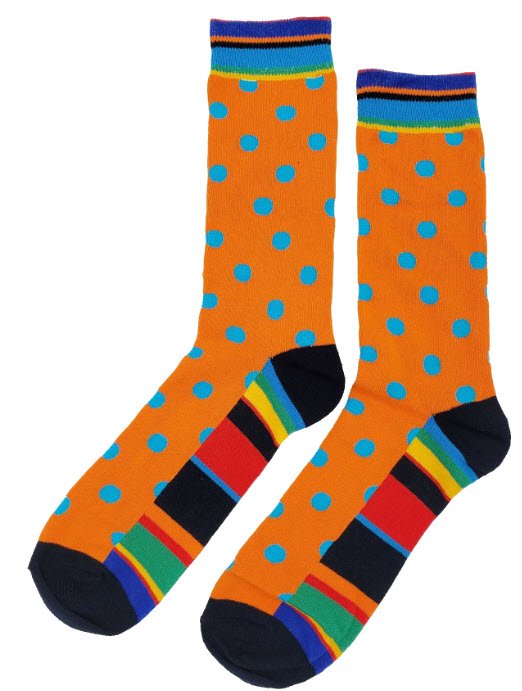
“This isn’t about the socks.”
Sometimes our kids (you know, the “kids” in their 40’s) comment on my husband’s and my “bickering.” We, of course, love each other heart and soul, AND we sometimes snap and bicker at each other. One of us says something, the other takes offense, responds in kind, or uses sarcasm. It makes people with us uncomfortable. We know it’s a bad habit, and we try to control ourselves. Thankfully, our little tiffs truly are small and quick. We exchange words, then move on.
I ran across the article below and thought it spoke to our situation. The other day, I made a sarcastic remark about where my husband chose to park the car. I could have thought, “This isn’t about the parking,” just as Rachel Macy Stafford thought, “This isn’t about the socks.” She wrote about grief, but I think it applies to anything that causes stress or emotions. A couple of weeks ago, as we prepared for a get-together at our house, my husband and I exchanged angry words over something he was making in the kitchen. I can’t even remember what it was. We are a great team, really, and enjoy hosting. We both pitch in with the cleaning, food prep, and everything else involved. But I notice that nearly every time we have people over, we end up arguing during the preparation. It seems to be the way we handle stress.
In the article, the author lists the many “disguises” grief, anxiety, hopelessness, and other emotions wear. Stress, too, wears disguises. Bickering, sarcasm, defensiveness, outbursts, anger, and more. Later, when the author talks about the grief with her husband, he says, “When I act like that, can you just put your arms around me and tell me it’s going to be okay?” Wouldn’t it be wonderful if we could remember to do that in the moment?
Stafford writes about preparing her heart for those moments. One time, when a friend and I were meeting with someone in his office—the two of us in chairs in front of the other person’s desk—I started to talk about something my friend felt was unwise to bring up. He unobtrusively put his foot softly on top of mine. I registered the silent tap and changed what I was saying. Another time, while observing an elementary classroom, I noticed the teacher walking up and down the aisles of students’ desks. Every so often, she would lay her hand softly on a child’s shoulder. I watched the children grow calmer and more settled.
I pray that when my emotions are rising, ready to defend myself, get angry, or blurt out a hurtful word, God will quietly, softly tap my heart, calm me, and remind me, “This isn’t about the…whatever it is.” That he will remind me to reassure whoever I am with—and myself—that it’s going to be okay.
Thoughts??
“This isn’t about the socks,” I thought to myself when my husband became overwhelmed trying to find a matching pair.
It was about the fact that his dad had just died.
By December of 2018, I’d had nine months to learn, mostly by accident, the role I needed to fill for my family. I needed to be a detective, because grief, I’d discovered, loves to wear disguises.
Sure enough, grief showed up as irritability, impatience, anger, detachment, and fatigue. But because I was looking for disguised grief, I was able to respond in ways that softened defenses and offered real support.
“That’s grief talking,” I remember repeating to myself when the intensity of my loved one’s frustration didn’t match the problem at hand.
Later, when I circled back after the sock outburst, I gently said, “The first holiday after losing someone can be especially hard. And when you’re grieving, even simple problems feel impossible. Next time you get frustrated, you can always ask me for help.”
I’ll never forget his beautifully vulnerable response -- one that has shaped our family ever since:
“When I act like that, can you just put your arms around me and tell me it’s going to be okay?”
That day, I learned that a loving response to someone’s deepest pain creates a healing shift—one that ripples far beyond the moment itself.
As December 8th approaches, which is my father-in-law’s birthday, I know there will be “not about the socks” moments. I am preparing my heart for them, and I thought this might help someone else prepare too.
As we move into another holiday season, it helps to remember:
Grief wears disguises.
Fear talks in unreasonable ways.
Anxiety gets controlling.
Hopelessness withdraws.
And when these emotions are present, it is not the time to lecture, turn away, or retaliate. It is a call to love.
When we understand that fear is talking,
that anxiety is talking,
that grief is talking,
we realize this moment is not about us.
It’s about tending to the hurting human in front of us.
And that clarity allows us to offer support that feels like two loving arms,
holding the possibility that things might be okay.
My hand in yours,
Rachel