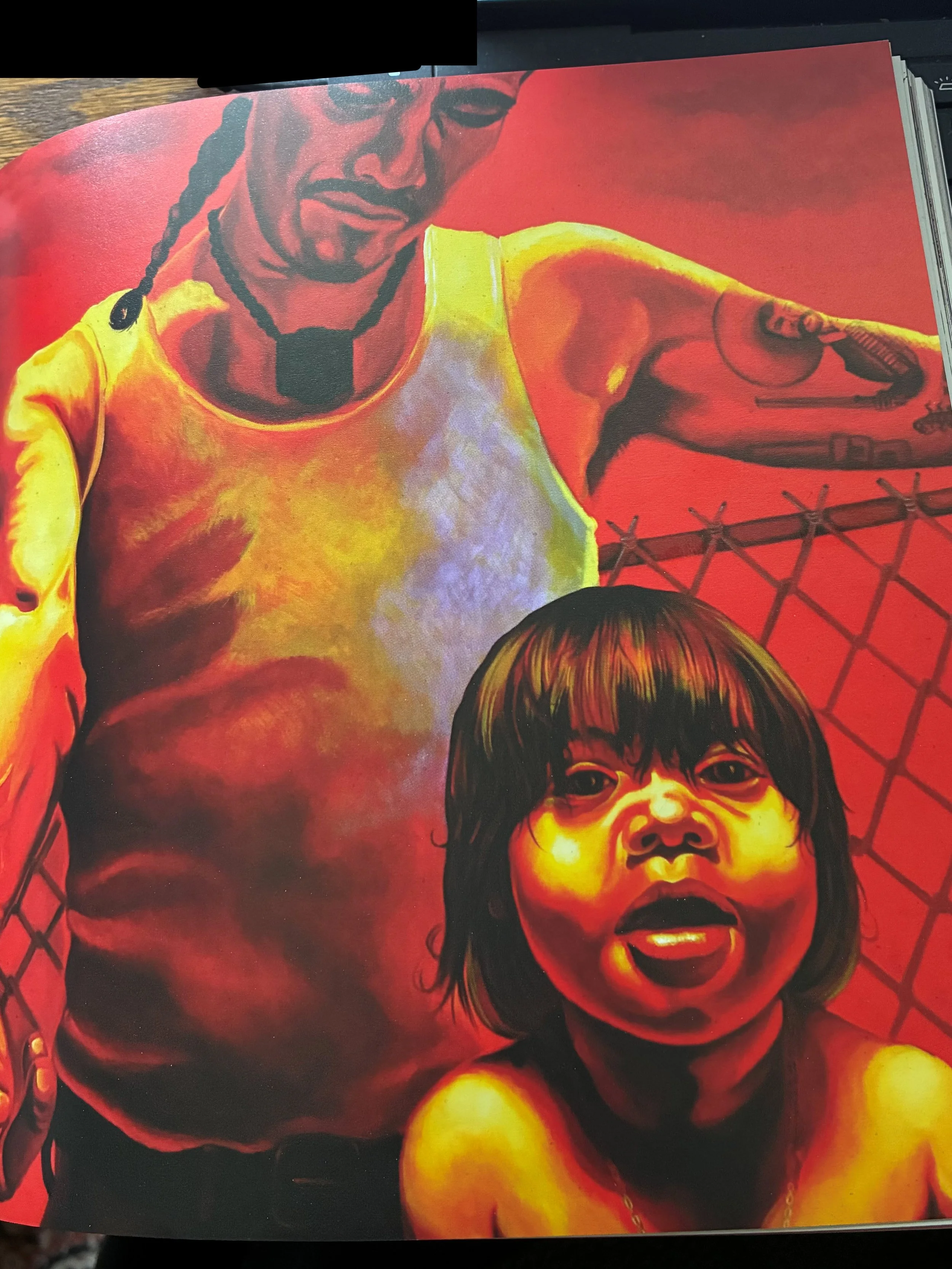
by Fabian Debora, the Executive Director Homeboy Art Academy. Page 19, Forgive Everybody Everything.
#6 - Forgive Everyone Everything - 5*
Gregory Boyle
2026
I couldn’t find a review of this book to link to that said something I always tell people when I speak of Father Greg Boyle—he is funny! Forgive Everyone Everything is a collection of 52 of Father Greg’s stories from his various books, compiled into a weekly devotional. I like it so much, I am planning to buy a copy for each of my kids. The stories are short, easy to read, touching, often funny, and give you pause.
I have written about Father Boyle many times (Google "Boyle” on my blog—https://www.mavismoon.com/search?q=Boyle—, and you’ll see!). He is one of my heroes. I have heard him speak several times at the Jesuit Retreat Center in Los Altos, which I often go to. He is a Jesuit himself and has a special relationship with the retreat center. When he speaks there, and nearly everywhere he speaks, he brings two of the “homeboys” from the Homeboy Institute he founded in Los Angeles. One of the things I often remember is what he said about “making good choices.” He said people often talk about needing to help others make good choices. But the thing is, these homeboys (and girls) have no choices to make. They are often trapped and have no choice.
Father Boyle began ministering to LA gang members in the ‘80s. They first tried mediation, but they realized that it was not working. Then they thought the best way to help would be to find jobs for the guys. That was effective, and eventually, with support and funding, Homeboy Industries was formed. They provide many services, both to men and women—not just jobs (where gang members often work side-by-side with rival members), but also housing, education, tattoo removal, counseling, and more.
Often, the humor in Father Greg’s stories comes from the homies’ unique use of words. Here are a few samples of his writing from Forgive Everybody Everything.
I asked Horacio if he had ditched school that day. “Noooo,” he said, “we didn’t ditch school—we just didn’t go.” My apologies. (page 4)
[From a homie who texts him up to 4 times a day.] “I’m fond of you,” he texts me once, from left field. I write back, “Well…I’m fond of you, too—and I’m grateful to God that you’re in my life.” His response is immediate: “The feeling is neutral.” I’ll take it. (page 40)
You can’t tell Rascal anything—except this one day, he actually listens. I am going on about something—I can’t remember what but I can see he’s listening. When I’m done, he says simply, “You know, I’m gonna take that advice, and I’m gonna let it marinate,” pointing at his heart, “right here.” (page 45)
Here is an entry called “Masterpieces.”
Anthony is in his mid-thirties and in his tenth month as a trainee at Homeboy Industries. He and his wife have three very young daughters. He was mainly missing in action for the birth of his first two. When the third is born, he holds her in his arms and tells me later, “Damn, G…I looked at her face and I thought, ‘She looks exactly like her mother—angry.’” We laugh.
Half of Anthony’s life had been spent in jails and detention facilities. Before coming to us, a meth addiction crippled him surely as much as his earlier gan allegiance did. We’re speaking in my office one day and he tells me that he and his twin brother, at nine years old, were taken from their parents and a house filled with violence and abuse and sent to live with their grandmother. “She was the meanest human being I’ve ever known,” Anthony says. Every day after school, every weekend, and all summer long, for the entire year Anthony and his twin lived with her (until they ran away), they were forced to strip down to their chonies, sit in this lonely hallway “Indian style,” and not move. “She would put duct tape over our mouths…cuz…she said, ‘I hate the sound of your voices.’” Then Anthony quakes as the emotion of this memory reverberates.
“This is why,” he says, holding a finger to his mouth, “I never shush my girls.” He pauses and restores what he needs to continue. “I love the sound…of their voices. In fact, when the oldest one grabs a crayon and draws wildly on the living room wall and my wife says, ‘DO something! Aren’t ya gonna TELL her something?’ I crouch down, put my arm around my daughter, and the two of us stare at the wall, my cheek resting on hers, and I point and say, ‘Now that’s the most magnificent work of art…I have ever seen.’”
Here is the Good News: The God we most deeply want IS the God we actually have, and the god we fear is, in fact, the partial god we’ve settled for. God looks at us and is ecstatic. This God loves the sound of our voices and thinks all of us are a magnificent work of art. “You’re here.” God’s cheek resting on ours. God’s singular agenda item. (page 25)
The book is also illustrated with awesome art by Fabian Debora, the Executive Director Homeboy Art Academy.
Let me repeat that: “God looks at us and is ecstatic. This God loves the sound of our voices and thinks all of us are a magnificent work of art.” God thinks—no, knows—you are a masterpiece.