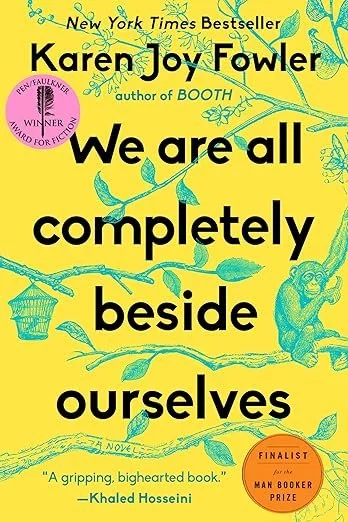
We Are All Completely Beside Ourselves -5*
Karen Joy Fowler
What a good book! As the author writes, it begins in the middle. This is a novel, written as if it were a memoir. Rosemary, the “memoirist” and narrator, begins the story of herself, her brother, sister, mother, and father in 1996, when “ten years had passed since I’d last seen my brother, seventeen since my sister disappeared.” (page 5)
Have you heard the term "unreliable narrator"? I thought of that while reading this book, especially in the first half. Rosemary gives her life story to various others in her life, and that is how you think you are learning her story. But, in some cases, afterward she’ll write something like:
That story I told Harlow—that story in which I’m sent to my grandparents in Indianapolis—obviously that story isn’t really from the middle of this story. I did tell it to Harlow just when I said, so my telling of it is from the middle, but the happening and the telling are very different things. This doesn’t mean that the story isn’t true, only that I honestly don’t know anymore if I really remember it or only remember how to tell it. (page 48)
Okay…not obvious to me. She goes on to say that “an oft-told story is like a photograph,” which I get. It is true that sometimes I am not sure whether my memory is real or based on photos. There are even memories I am not sure whether they happened or were a dream, especially from when I was very young. But, I guess, at least for me, that doesn’t happen—as far as I know—with something as significant as whether I went to my grandparents’ home or not, for example. Anyway, I started reading the narration with a grain of salt, waiting to see whether she would reveal its veracity. (Although, of course, it is fiction, so not literally the truth, but you know what I mean. True for this story.)
Every so often, I appreciated her dry humor and sarcasm, or at least the bordering-on-sarcasm. For example, she wrote an entire paragraph about her father’s theory of child development, drawing on Jean Piaget’s expertise. Then, a few pages later, she described a childhood home and ended with:
My new room may have been bigger than the bright little nook I’d had in the farmhouse, but I could see that the house itself was smaller. Or maybe I coudn’t see that when I was five. Ask Piaget.
I liked her love of The Lord of the Rings, which she referenced as an aside a couple of times. In one case, she found a note from her brother in her copy of Fellowship of the Ring because “He knew I reread that trilogy often; he know that the day would soon come when I’d need the consolation of the Shire.” (page 118) That’s me! As I grew up, I reread The Hobbit and The Lord of the Rings trilogy about every other year. I would think, “I need a visit to Middle Earth.” Another time, she describes a room that had been trashed:
We are Romans amid the ruin of Carthage; Merry and Pippin in Isingard. (page 290)
Cool! Referencing The Lord of the Rings as if it were a classic literary allusion—equivalent to the Roman Empire, maybe even the Bible.
I’m leaving out a key fact (and it is an actual fact in the context of this story) about Rosemary’s sister Fern. If you read the book based on what I’ve written, I think it would be a good experience for you, as it was for me, not to know that key fact until Rosemary reveals it. If I had read the back cover and other reviews, I would have known, but I only skimmed the back cover and missed it. So, finding out about Fern was a surprising twist for me, and I liked it.
I highly recommend We Are All Completely Beside Ourselves. Fun, funny, well-written, quirky but believable characters, twisty plot, intriguing, and thought-provoking. I think you’ll like it.