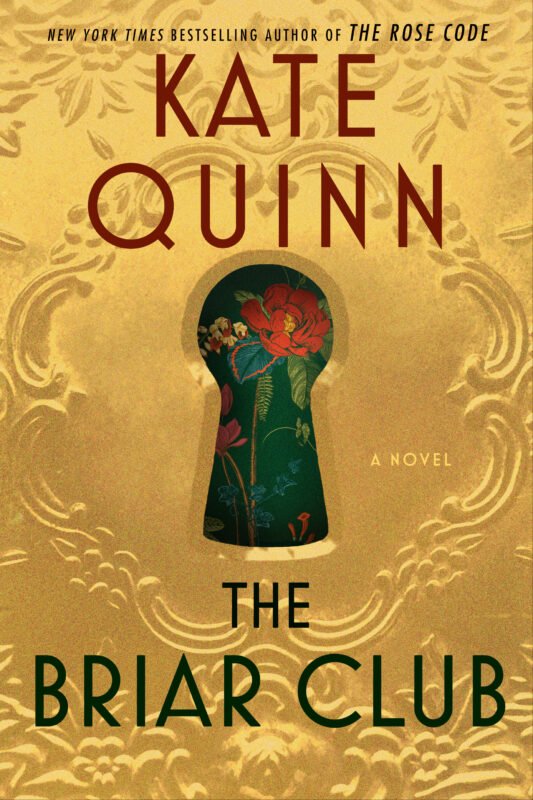
#5 - The Briar Club - 5*
Kate Quinn
2026
If I’d have read that The Briar Club was a historical fiction novel, I might not have even picked it up. I often do not like historical fiction. To me, some of them are sentimental or “gushy,” portraying the historical person(s) as unrealistically heroic. There is a word for a biopic that does that—makes the celebrity practically a god—but I cannot think of the word or find it. Anyway, The Briar Club did not strike me that way, thankfully!
The book is about a boarding house in Washington, DC, and the people living there. It is set during the McCarthy era. There are historical figures and events spoken of: McCarthy, the president, the Korean War/Military Action, the women’s baseball league, and others. I did not recognize any of the characters as a real person, but there are some reviews that claim the characters are based on real people.
I enjoyed the book. It begins kind of strangely, with the house itself talking. I liked it, though. It was fun to imagine the house observing everything going on and wishing for certain outcomes, enjoying some things and not others.
The main character is Grace March, the “lovely, mysterious widow” (from the book flap) who moves into the attic room. Each chapter, though, is narrated by a different character, including the house itself. It starts with a murdered body being found, and as you read, you find out what happened that led up to the murder. Each of the characters is interesting. It is fun to read the thoughts, motives, and actions of:
poised English beauty Fliss, whose facade of perfect wife and mother covers gaping inner wounds; policeman’s daughter Nora, who finds herself entangled with a shadowy gangster; frustrated baseball star Bea, whose career has come to an end along with the women’s baseball league of World War II; and poisonous, gung-ho Arlene, who has thrown herself into McCarthy’s Red Scare. (book flap)
As the chapters unravel what happened, you get to know each person, and understand how they became a part of the murder mystery. For a little extra fun, there’s a recipe for each chapter and each person. Food is a central player. When Grace moves in, she starts inviting everyone to have dinner together once a week, with alternating persons cooking. The house is rather bleak, and the boarders keep themselves to themselves, mostly thanks to the owner of the house, a bitter, stingy widow with two young children. Grace’s dinners happen while she is at her weekly bridge game. Not only do friendships grow, but the house becomes a nicer place to live as Grace begins painting the walls of her room with flowers, and others join in.
I cannot remember reading anything else set in the McCarthy era and it was intriguiging to see the effect of the Red Scare. I heard of it in history classes, but it made it more real to get to know people living in it and affected by it. As I think back on the book, I realize, too, that Quinn did a good job of making it feel true to the time. Sometimes books (or movies) bring in sentiments or words that make me wonder, “Did people really feel that way back then? Or say that?” I never thought that once while reading this book.
No one knows who Grace really is. That is a mystery until the end, just like the murder. I did not figure it out and enjoyed the revelation.
I recommend The Briar Club!