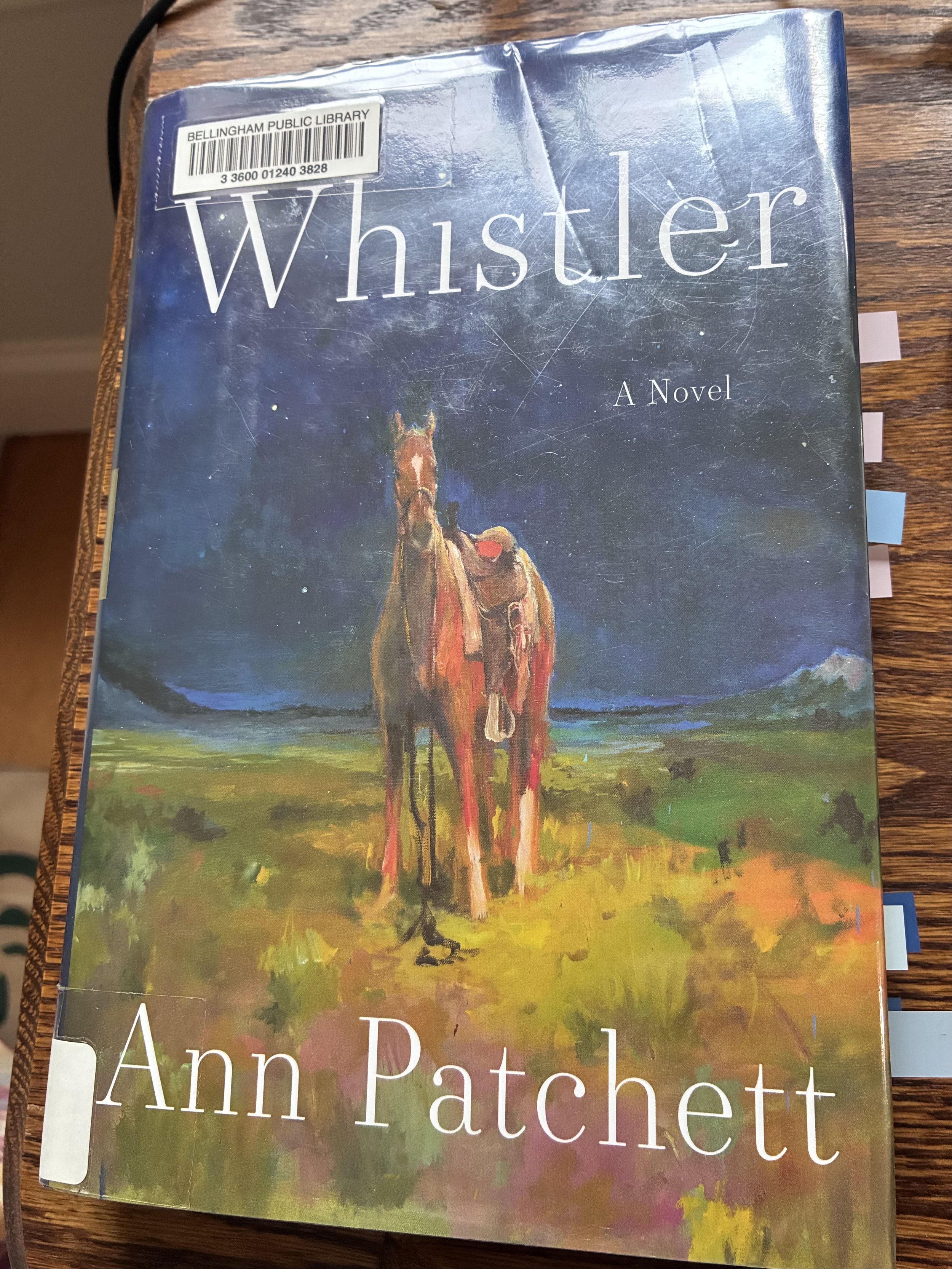
Whistler - 5*
Ann Patchett
It’s been a long time since I binged a book. I started it one day, then sat and finished it the next in a 6-hour binge. It’s not that it’s suspenseful. There are no mysteries other than a slow reveal of a critically important event in the characters’ lives. The summary I read the most was:
When Daphne Fuller and her husband Jonathan visit the Metropolitan Museum of Art, they notice an older, white-haired gentleman following them. The man turns out to be Eddie Triplett, her former stepfather, who had been married to her mother for a little more than year when Daphne was nine. Now fifty-three, Daphne hasn’t seen Eddie for many years, not since the fateful event that changed the direction of both their lives. Meeting again, time falls away; while their relationship was brief, it had a profound impact on them both, and now that they are reunited, they have no intention of ever being separated again. ~~annpatchett.com/books
When Daphne saw her stepfather, Eddie Triplett, she was 53, and he had been her stepfather for a short time when she was nine. We spend much more time as an adult than a child, yet our childhood so shapes us.
How was it that a weekday trip to a museum with my husband had plunged me into childhood at the age of fifty-three? I knew what Leda [Daphne’s sister] would say. She would say it was because childhood never leaves us. We seal the room up and cover it in sheetrock. We dry and sand and paint, but the pocket of history remains, and sooner or later someone always winds up tapping on the wall, commenting on the way it sounds strangely hollow in there, and then the whole thing comes tumbling down. ~~pages 166-167
Daphne and her sister had a chaotic childhood. Their mother married three times as they were growing up. Some of the husbands were bad news, and their mother was not very loving. Once, Daphne wondered aloud to her sister, a therapist, “How do you think it was we weren’t destroyed?”
“Compared to most people?” she said. “Oh, honey, you have no idea what people do to their children. Our childhood was fine.”
The news surprised me. “Was it?”
“We were loved, not passionately but enough, and we were largely ignored, which allowed for our healthy separation from the primary family. Necessity made us resourceful and brave. We were left to solve our own problems and so we did.” ~~page 237
“Largely ignored,” the opposite of helicopter parents. I tend to think I didn’t do enough as a mother. But maybe I did okay.
I’ve read several books by Ann Patchett and always appreciate her writing even when I don’t love the book as much as I did this one. In this book, I noticed these little asides Patchett used. Sort of like a comment from the author (or narrator? or the character herself?) about what the person said. Like this:
“They’re very attached to you,” I offered from the backseat. We hold these truths to be self-evident. ~~page 210
See? Who’s saying/thinking, “We hold these truths to be self-evident”? Whoever. It made me smile.
A key part of the book is a story about a horse named Whistler. Until this story came up, around halfway through the novel, I kept wondering why the cover had a picture of a horse and what in the world “Whistler” had to do with it. When Daphne was nine, her stepfather Eddie Triplett told her the story of Mary Carter and her horse Whistler. The horse is called that “because even when the horse was young, Mary could stand in the pasture and whistle for her and the horse would come.” (page 127) Mary rides Whistler to look for a lost horse when lightning strikes, making Whistler rear up and Mary fall. Whistler runs away.
Mary ends up hurt, unable to move, and in an area her family never normally went. She lies there for hours—days. As her life ebbs away, she is visited by friends and family who have died ahead of her. They comfort her. As she is accepting her death, she remembers: whistle. Whistler comes and rescues her. (pages 137-139). I want you to know the story, but I’m sorry I have to summarize it because it’s a beautiful story in full.
I won’t reveal the spoiler about why the Whistler story is so key. I enjoyed learning the story along with Leda when Daphne told it to her. I also enjoyed another surprise about why Daphne’s mother divorced Eddie Triplett. I hope you’ll read the book.
There are, as you might guess, a lot of references to death in the book. No doom and gloom, I promise. Good things to think about. Daphne’s husband is away part of the time, clearing out his mother’s house after her death. Eddie is dying of cancer. Daphne shares memories with her husband Jonathan about Eddie’s lifelong friend Skip Hotalling. Friendship is one of them. When my brother died, his friends from work were some of the most faithful companions both to him and to my sister-in-law. It made me realize how important friendship is. This book does that, too.
Death, friendship, love, family, memories, stories, tenderness, humor, great writing—please read Whistler by Ann Patchett.