The Wager: A Tale of Shipwreck, Mutiny and Murder - 4*
David Grann
An epic tale!
The Wager is a grand tale of human behavior at the extremes told by one of our greatest nonfiction writers. Grann’s re-creation of the hidden world on a British warship rivals the work of Patrick O’Brian, his portrayal of the castaways’ desperate straits stands up to the classics of survival writing such as The Endurance, and his account of the court-martial has the savvy of a Scott Turow thriller. As always with Grann’s work, the incredible twists of the narrative hold the reader spellbound. Most powerfully, he unearths the deeper meaning of the events, showing it was not only the Wager’s captain and crew who were on trial—it was the very idea of empire. ~~from the front flap
The voyage started on August 23, 1740. The Wager was one of a squadron of 7 ships. They were commissioned to battle with Spain. To do that, they had to go around Cape Horn, which even I, in my tiny knowledge of this time in history, know to be an incredibly dangerous route. The waves and weather are killers.
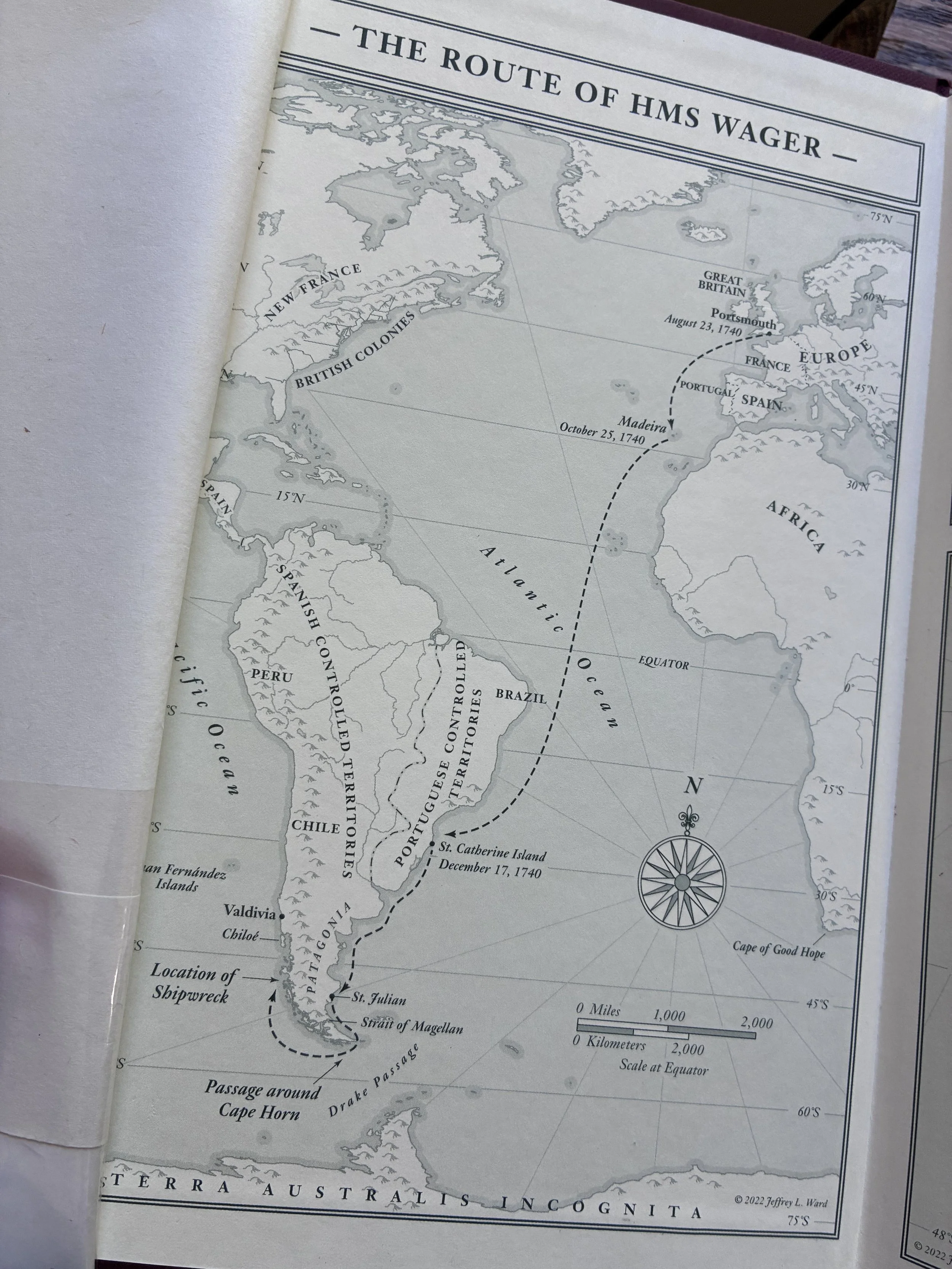
I was glad I had seen the movie “Master and Commander.” (Highly, highly recommend!) It enabled me to imagine the details of life on a warship. What I didn’t know was how bad they had it as far as medical knowledge. The Wager already seemed doomed because its crew was made up of sick, near-death sailors, Marines with no experience, and men and boys pressed into service (captured and forced to serve). Added to that, they were plagued—literally—with typhoid and scurvy, neither of which anyone knew how to prevent or treat. The majority of the crew died during the journey.
They also had little knowledge of navigation. There were maps but no way to accurately measure where they were.
They were forced instead to rely on “dead reckoning”—a process using a sandglass to estimate time, and a knotted line dropped in the sea to approximate the ship’s speed. The method, which also incorporated intuition about the effects of winds and currents, amounted to informed guesswork and a leap of faith. Too often for a commander, as Sobel put it, “the technique of dead reckoning marked him for a dead man.” ~~page 65
The romantic movie shot of a sandglass on a ship accompanied by bells holds a lot more meaning than I knew.
The survivors shipwrecked on a barren island off Patagonia. Now, starvation killed even more. The island had very little to offer for food. The men managed to make shelters, but struggled to survive. Not to mention the stealing, fighting, and killing.
It’s amazing anyone survived, let alone made it back to England, but some did!
On January 28, 1742, a ramshackle vessel of patched-together wood and cloth washed up on the coast of Brazil. Inside were thirty emaciated men, barely alive…
Six months later, another, even more decrepit craft landed on the coast of Chile. This boat contained just three castaways. ~~from the front flap
The detailed storytelling testifies to David Grann’s immense research. The notes, index, and bibliography take up 60 pages. I can’t believe he wrote several other books which appear to have the same amount of voluminous research. Just this book looked like a lifetime’s work to me. All the detail did not make the story boring or “text-booky.” I must confess I did some skimming just because I wanted to get to the action of what happened when the survivors made it to England, but the writing really was great. It was an honest-to-goodness ship’s yarn.
I love words, including their etymology, so I enjoyed this:
During the age of sail, when wind-powered vessels were the only bridge across vast oceans, nautical language was so pervasive that it was adopted by those on terra firma. To “toe the line” derives from when boys on a ship were forced to stand still for inspection with their toes on a deck seam. To “pipe down” was the boatswain’s whistle for everyone to be quiet at night, and “piping hot” was his call for meals. A “scuttlebutt” was a water cask around which the seamen gossiped while waiting for their rations. A ship was “three sheets to the wind” when the lines to the sails broke and the vessel pitched drunkenly out of control. To “turn a blind eye” became a popular expression became a popular expression after Vice-Admiral Nelson deliberately placed his telescope against his blind eye to ignore his superior’s signal flag to retreat. ~~page 35
One of the surviving seamen on this voyage was John Byron, 16 years old when the journey started. He was the great-grandfather of the famous Romantic poet, Lord Byron. John Byron wrote about his adventures, and his great-grandson used some of his stories in his poems.
John Byron and his companions called the Kawésqar (Ka-WES-kar) people, who briefly lived with the marooned sailors, savages.
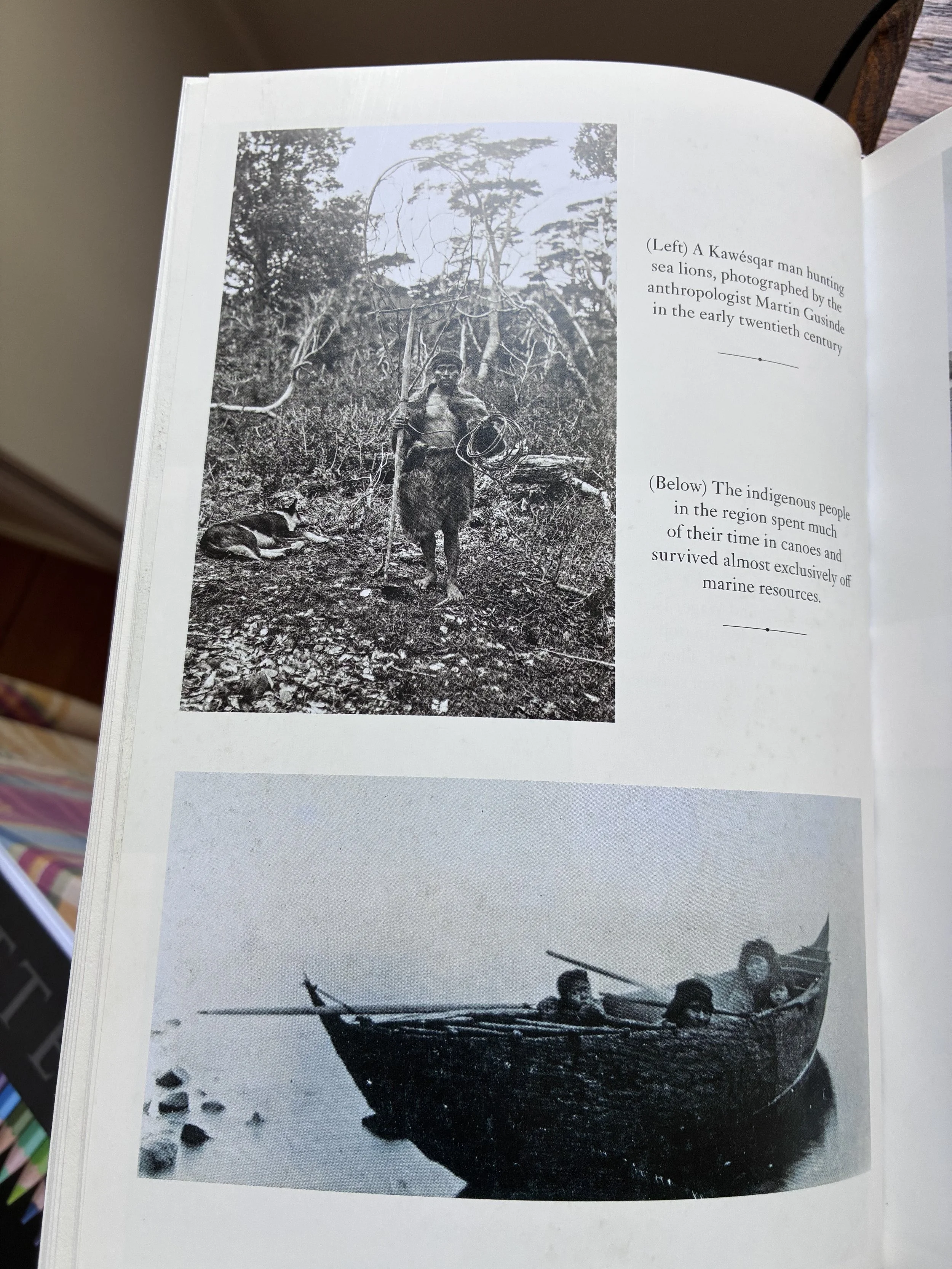
The Kawésqar had a population of a few thousand, and their territory spanned hundreds of miles along the coastline of Chile… They generally traveled in small, familial groups. Given the impossible terrain, they spent much of their time in canoes and survived almost exclusively off marine resources. They have been called the nomads of the sea. …
They were skilled navigators, especially the women, who typically steered and paddled the canoes. These long vessels were only about a meter wide, but each one had room to transport a family and its prized dogs, which served as night guards, hunting companions, and heat-bearing pets. …
European explorers, baffled by how anyone could survive in the region—and seeking to justify their brutal assaults on indigenous groups—often labeled the Kawésqar and other canoe people as “cannibals,” but there is no credible evidence of this. The inhabitants had devised plenty of ways to find sustenance from the sea. The women, who did most of the fishing, tied limpets to ropy sinews and dropped them in the water, waiting to jerk a prize upward and grab it with one hand. The men, responsible for hunting, lured sea lions by singing softly or slapping the water, then harpooned them when they rose to investigate. Hunters set snares for geese that wandered on the grassland at dusk, and they used slingshots to pick off cormorants. At night, the Kawésqar waved torches at nesting birds at nesting birds to blind them before clubbing them.
To keep warm, they oiled their skin with insulating seal blubber. … In canoes, the fires were burned on sand or clay hearths, and the children were often responsible for stoking them.
The Kawésqar were so well adapted to the cold that centuries later NASA, hoping to figure out ways for astronauts to survive on a frozen planet, sent scientists to the region to learn their methods. ~~pages 125-126
The Kawésqar stayed with the survivors for a while and helped them by providing food.
But after only a few days, the carpenter’s mate Mitchell and other sailors began to run amok again. Defying Captain Cheap’s orders, they were stealing liquor and carousing and absconding with weapons from the wreck…Byron noted that these men—”now subject to little or no control”—tried to “seduce” the Kawésqar women, which “gave the Indians such offense.”
Word spread throughout the encampment that Mitchell and his marauders were conspiring to steal the Kawésqar’s canoes and flee the island…
One morning when Cheap awoke, he discovered that all the Kawésqar had gone. They’d stripped the bark from their shelters and slipped away in their canoes, taking with them the secrets of their civilization. ~~page 130
When the survivors made it home, several of them wrote and published stories of their journey and shipwreck. Inevitably, the accounts differed according to who wrote them and who they wanted to protect, whether it was themselves or others. To me, even though there was widespread murder and mayhem, the respect for naval hierarchy was amazing.
The Wager is another book I never would have picked up if not for my book club. It’s a great read.