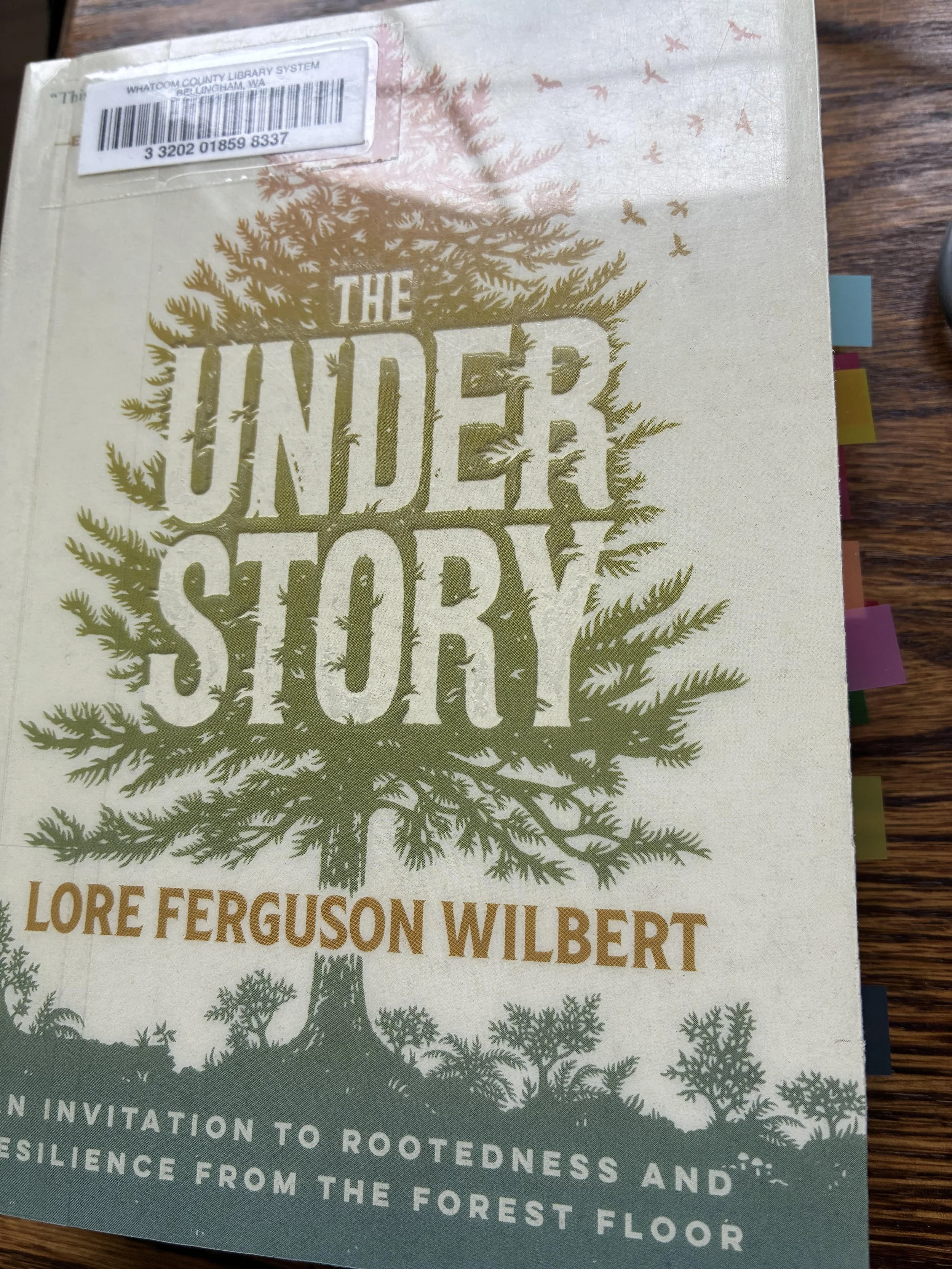
The Understory: An Invitation to Rootedness and Resilience From the Forest Floor
Lore Ferguson Wilbert
“No one was going to make it through 2020 unscathed. No one.” —page 18. That line grabbed me. 2020 / Covidtide, whatever you want to call it, is kind of strange. I wonder if people will think of it later the way we think of “the depression.” I grew up hearing people talk about “during the depression” the way I now hear and speak of “during Covid.” In my mind, it feels the way trips or vacations feel — looking back, they seem almost like a dream. As I read The Understory, I often remembered and almost re-experienced how I had felt during Covid.
The book is more, much more, than a memoir of Wilbert’s life during and around the time of Covid. Book reviewers write things like this:
The Understory: An Invitation to Rootedness and Resilience from the Forest Floor is a collection of reflections on the way we grieve and grow. Using the undergrowth of a forest as both spine and central metaphor, Lore traces the way we struggle, grieve, and share our lives while accepting where we are, whether we would have chosen it or not. This book is about the interconnectedness of natural life, and, no matter how awkward or painful it feels, of our communities. —Julie Cox, “Review of The Understory.” April 13, 2024. https://www.juliekcox.com/blog/review-of-the-understory.
Wilbert and her husband, after many moves, live in the Northeast, a small town in New York where her family lived for a part of her youth. She uses things that make up the forest floor as a framework for her collection of essays: space, land, soil, forest litter, lichen, nursemaids, weeds, mycelia, and the forest. She describes each part and uses each as a metaphor for her reflections. In her chapter about mycelia, Wilbert says that for many years, foresters thought different tree species were in competition with each other. They planted only one species after clear-cutting, but a scientist named Suzanne Simard discovered that the different species of trees have a:
vast underground network of mycorrhizal fungi. This network provides a pipeline between trees of various species sharing both carbon and nitrogen in a symbiotic relationship. She called it ‘mutualism,’ imagining the relationship between birch and fir as ‘weaving a network as brilliant as a Persian rug.’ —page 179
Wilbert came from a childhood that included an angry father who believed government agents were going to capture them at any moment, and a religion with many rules and taboos. She trusted the leaders of that religion and the people in the community who surrounded her family. In and around 2020, she started to break away from the beliefs that the community held. When she expressed her different opinions about things such as masking policies, the election, and so on, she lost family and friends in which she had thought she was in lifelong relationships. She, like many, had a hard, depressing, disorienting time navigating the losses.
When she and her husband settled in the town in New York, their neighbors held diverse opinions, as is nearly almost true. One neighbor posted liberal slogans, another flew the Confederate flag, others were in a same sex marriage, etc. Wilbert wrote about a time when she and her husband accidentally started a fire in their kitchen (she thought she was putting vinegar in a pan, but it was isopropyl alcohol). They texted a neighbor when they left for the ER to get their burns treated. While they were at the hospital, their neighbors cleaned everything up. Other neighbors — these wildly different-opinionated neighbors, some of whom had not spoken to them since the time of Covid — brought casseroles, desserts, meals, did some gardening for them, and more.
What an embarrassment of riches. What a cornucopia of community. None of these people were our best friends, those with whom we felt a deep kinship and intimacy. They were just ordinary people in an ordinary community moved by ordinary care for other humans in a moment of need — despite the fact that some might view their political views, lifestyle, church, or beliefs as incompatible with neighborliness. —page 184
She goes on to talk about how she had felt afraid to be with others “who would disagree vehemently with one another,…those who weren’t like me, afraid I’d veer off into beliefs or practices that would dishonor God.”
But the opposite happened. The more unstuck from my echo chambers and groupthink environments I became, the less I felt the need for approval,…the more spacious my heart became, and the more I just wanted to be a person who loved Jesus and let the rest of it work itself out. —page 185
“A person who loved Jesus and let the rest of it work itself out.” I think I’ll change my bio from “I am a Jesus follower” to “I love Jesus and am loved by Jesus.” That’s who I am.
I liked Wilbert’s running theme of being here.
Perhaps a person can move through life, every action of theirs birthed on the precipice of ‘Tomorrow I might die,’ but I wonder what might change if instead we said, ‘Today I am here.’
This has become my own mantra of sorts, the breath prayer I draw in: I am here.
But my being here is nothing without God being with me, and so I exhale: And you are here with me. —page 35
I highly recommend this book.