Make Your Home in This Luminous Dark: Mysticism, Art, and the Path of Unknowing by James K.A. Smith
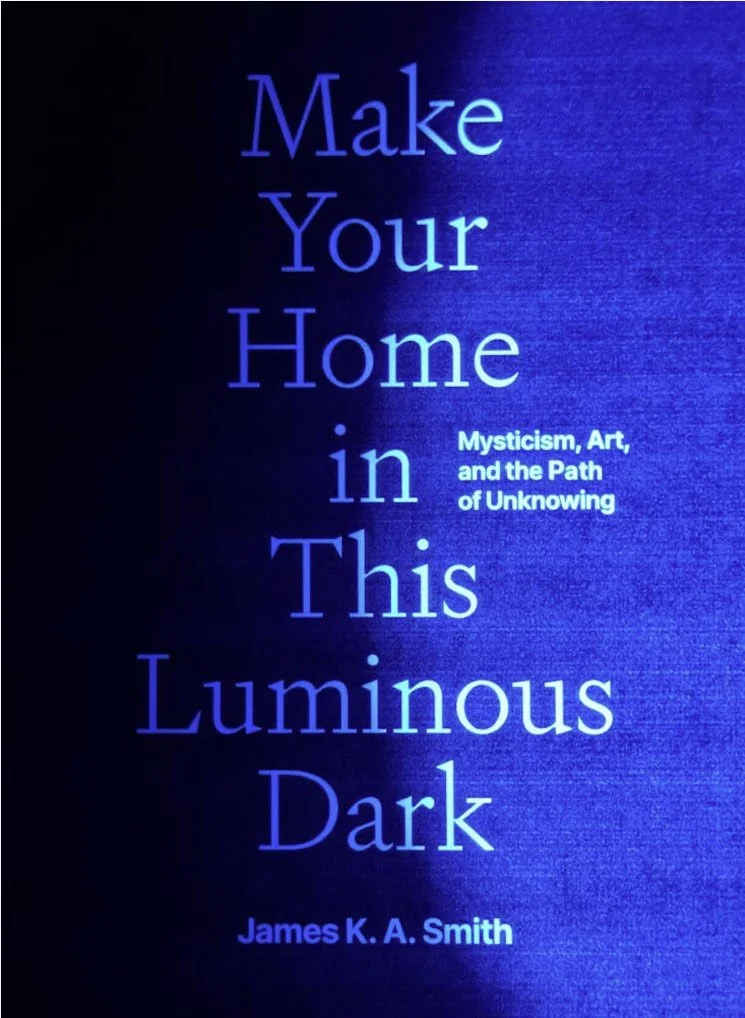
Make Your Home in This Luminous Dark: Mysticism, Art, and the Path of Unknowing - 5*
James K.A. Smith
Years ago, in a church small group, we were choosing a book for our Bible study, and the pool of choices included a study guide written by my brother. I had contributed it, thinking it would generate good discussion and, of course, thinking it was an excellent choice written by my brother I loved and thought a smart, engaging, well-versed writer. As we reviewed each book, when we came to his, the leader said, “If we want a scholarly book, this one would be good.” Well, I thought, that killed that idea! “Scholarly” can be a backhanded compliment sometimes. My brother has a PhD and is one of the most intelligent people I know, but still, I thought it was unfair to sum the book up that way, taking it off the table with one word.
So, I do not want to say that this book is scholarly and cause you not to even give it a chance. It has big words. Over the years, I have often received comments about my use of big words. I think it’s from all my reading. What people label big words come to mind as I am talking. They just fit. They express more exactly what I want to say than smaller, simpler words. I used to edit myself and try to avoid big words, but now I just let them rip. :) In this book, James K.A. Smith, who also has a PhD and is very intelligent, uses big words to, I am sure, more precisely say what he wants to convey. It slowed me down. Sometimes I would re-read a sentence or paragraph to soak in what he wrote. I thought it was kind of like poetry, which slows you down. It’s a good thing.
The concept of a “luminous dark” that Smith writes about, as he names in the subtitle, is the unknown: art, practices, mysticism, and experiences that we cannot fully (or at all) understand. He quotes the naturalist Barry Lopez, then describes what he means by “dark”:
‘I gravitate toward environments of uncertainty,’ Lopez confessed. I understand the allure now. Confusion no longer scares me. Lack of clarity is not a sign of epistemic failure. I’ve learned how to make a home in the dark, to dwell patiently in the unknown. (page 27)
Interesting idea, isn’t it? To settle down and enjoy not comprehending something, not being able to summarize what the artist meant, not coming to a resolution, not trying to resolve the feeling of discomfort or awkwardness you’re having while participating in something. I think I am not alone in wanting to “figure it out” pretty much all the time.
I think we’re used to knowing we cannot understand God. We often hear “It’s a mystery” about God. Smith takes this further.
The late medieval author of The Cloud of Unknowing writes that contemplation reaches a point of wrestling with a nothingness — which is a prelude to giving up the illusion that the divine could be conceptually grasped. “Persevere in contemplation with a renewed longing in your will to have God, remembering that your intellect cannot possess him.”…Incomprehension, in these matters, is a measure of its worth. (page 38)
God is more worthy and glorious because I don’t understand him. I had not really thought of it that way before.
Similarly, Smith writes of other things that gain worth because they are incomprehensible.
To experience confusion and bewilderment is not a failure of meditation, [Thomas] Merton emphasizes. Instead, ‘this bafflement, this darkness, this anguish of helpless desire is a fulfillment of meditation.’ (page 37)
And:
Art that is experimental, abstract, and nonrepresential…pulls us into new modes of awareness precisely by eluding our available concepts and unsettling our hermeneutic horizons…art we so often think of as “secular” — that invites, even demands, the sort of contemplative posture that might make us open to the mystical. (page 37)
I confess that I have never gotten much from abstract art. I try not to be boorish about it and think it’s “bad art” or something. I figure the artist had reasons for what they made that I don’t understand.
A while back, I read something that said to try spending a little more time when looking at art. The author said to take a few minutes to look more closely, and you’ll notice things you had not before. That has much increased my enjoyment of art. Rather than just thinking, “That’s a girl,” “That’s a picture of a field,” “There’s a person and a horse,” or whatever, and moving on, I stop, look more closely, and find a lot more in the picture or piece of art than I saw with just one look. It still doesn’t often make me feel like I necessarily understand it. I just think, “I notice there’s a little dog back there,” “I notice tiny angels around the edges,” “I notice there’s a face in that mirror behind them,” and so on. Somehow, noticing more adds to my enjoyment. I was struck by one sentence where Smith says, “We are blocked from seeing by familiarity.” (page 41)
With abstract art, though, often there doesn’t seem like a lot to notice. Smith describes finding an art gallery by an artist he had never heard of and being baffled by what he saw.
Paolini’s installations ask for something other than devotion; his work occasioned in me a kind of wondering that was something other than awe, inviting conversation rather than adulation. The artist is relinquishing control rather than demanding attention. (page 41)
Another new thought for me. I realized I (we?) look at art to admire, to be awestruck. Abstract art does not evoke admiration or awe in me. In fact, I have to be careful not to think, “Well, I could do that,” or “A five-year-old could make that.” Pretty much the opposite of admiration. Smith talks about a conversation rather than admiration, even “commun[ing] with an artist who is as perplexed and dazzled by the world as I am.” (page 42)
I wondered how to do this — how to have a conversation, or commune, with the artist. Just trying to notice more wasn’t going to get me far. Smith describes going through the unfamiliar artist’s gallery asking questions of himself.
None of the lines match up. How much do I want them to? How much is my mind trying to “correct” all this? How much of me revels in the disruption? Tbe geometric echoes capture something of our human craving for mastery. Here is a Euclidean world governed by the axiom, shaped by the algorithm. But the disrupted angles and jumbled grids push back. There are things in heaven and earth that can’t be subject to your algorithms, Horatio. Thank God. I am immersed in this exhibition, with no idea what’s going on, and loving every second of it. I love it even more for its inscrutability. (page 41)
It reminded me of something I have found helpful when I am having a strong emotion, such as anger, sadness, or envy. When I remember, I try to be curious about what’s going on inside my own body and mind. I pretend I’m a friend or therapist and ask, “Mavis, why are you feeling this way?” I note, “Your eyebrows are up, your mouth is tight, what’s going on?” And I don’t let myself off the hook. I answer myself, then keep probing. And why? why? What is this reminding you of? What else has made you feel this way? And so on. I could use that same kind of approach with unfamiliar art or uncomfortable practices.
I wonder if that curious questioning approach would work best with a gallery or installation rather than a single piece of art. I wonder if I’d run out of questions to ponder. That, in turn, made me think of a method of prayer I learned about years ago. The author called it “coloring with prayer.” She described how sometimes she wanted to pray for someone or about something, but would run out of things to pray for. After asking God to make someone well, for example, she might think of a few more things to ask, such as please help the doctors, be with the caretakers, and a bit more, but she wished she could spend more time in prayer for this particular need, but ran out of words.
What she started to do was doodle, basically. She would doodle something, “decorate” it (as she described it), and spend time in that coloring activity while holding the person in her mind. I have found that concept helpful. I like to color little cards you can buy with verses or sayings. Now I sometimes color them as a kind of “prayer card,” holding a person in my mind as I color. People make “prayer shawls” this way. Really, you can make almost any activity into a prayer, can’t you? When I cook something for someone, that is a prayer.
Anyway, maybe I could look at a piece of abstract art and somehow “hold it in my mind” in a similar way. It’s a thought.
The things I have written about so far are just at the beginning of the book. Smith goes on to discuss solitude, silence, mysticism, union with God, our “affirmation dependency,” detachment, meditation, awareness, wisdom, befriending failure, love, being loved — being the beloved, relinquishing control, independence, ignorance, communion, and more. I found a lot to think about. I highly recommend it!

Lots of dogeared pages and underlining — the sign that I was struck by what I read many times.