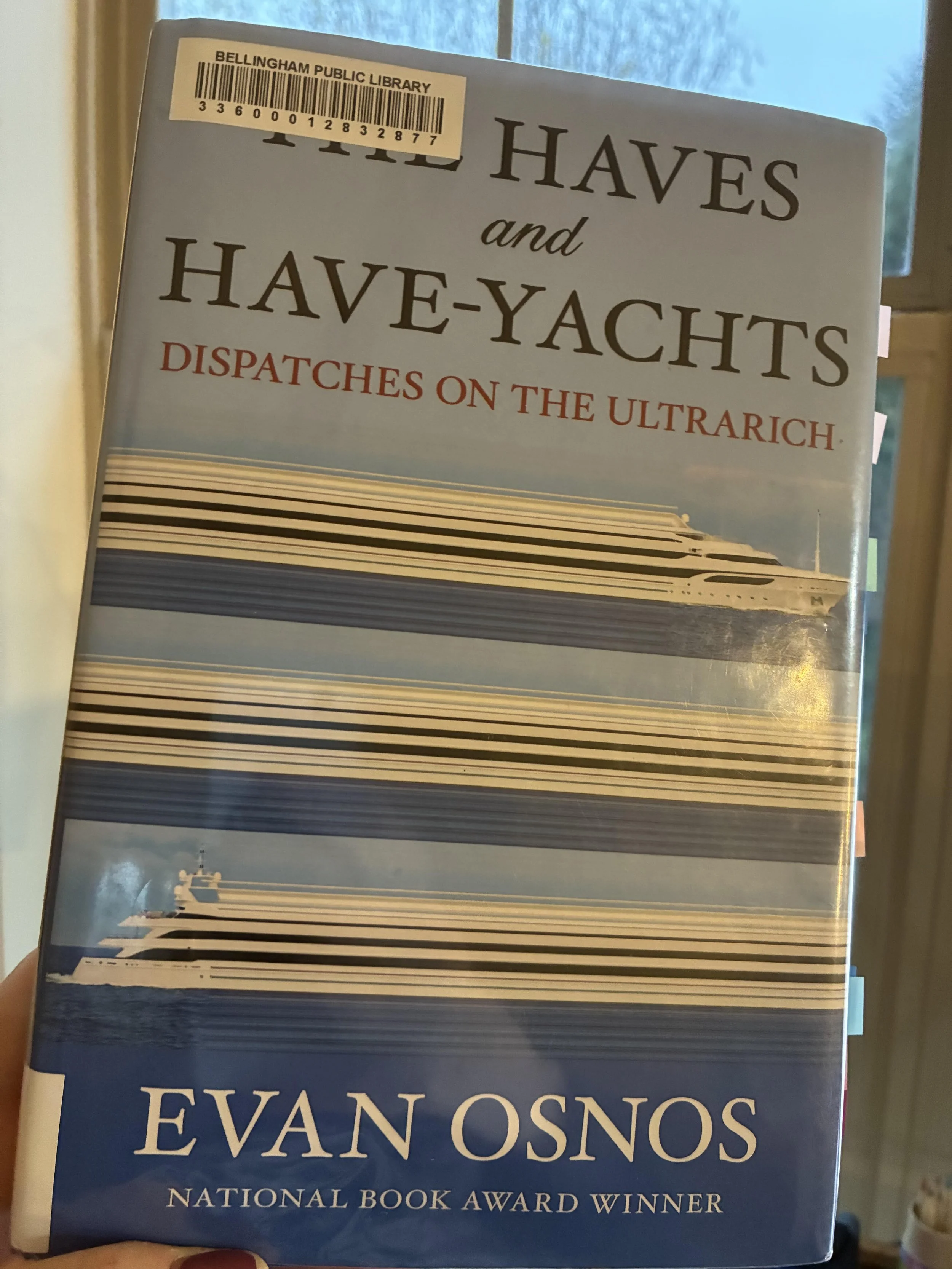
The Haves and Have-Yachts : Dispatches on the Ultrarich by Evan Osnos
…when the media baron William Randolph Hearst told his wife that he’d bought a Norman castle in Wales, she reputedly replied, “Norman who?” (page xv)
Ha ha! Just one example of the witty, engaging writing in The Haves and Have-Yachts : Dispatches on the Ultrarich. I first heard of it on one of my favorite podcasts, Death, Sex, and Money. The host, Anna Sale, calls the book a “juicy read.” I agree! It does contain statistics, such as “Since 1990, the United States’ supply of billionaires has increased from sixty-six to more than eight hundred, even as the median hourly wage has risen only 20 percent,” (page 5). Or another shocker: “…in 1965, the CEO of an average large public company earned about twenty times as much as a front-line worker. Today, that figure is 178 times.” (page 127)
Still, it is far from a dry report of the rich, or one percent, or whatever. It’s full of fascinating stories. Often, I really could hardly believe what I was reading. Surreal. I remember that during a recession, when my husband was laid off, we were careful with our budget. We went wine tasting, and I stood in line to buy my one bottle as the person in front of me paid over $400 for a whole case. Another time, we attended a beautiful wedding for wealthy friends and stayed in a luxury hotel we could never have afforded. I watched the expensive cars arrive in front, the workers piling their luggage on gilded luggage carts and jumping in the driver’s seat to valet their vehicles. In both cases, and others, I would think or say, “There’s a whole other world out there.” And, wow, did this book corroborate that. Honestly, sometimes I felt literally dizzy.
The yachts in the title have grown exponentially, not just in quantity but in SIZE. Owning a superyacht, as the enormously long ones are called, is not about sport, pleasure, vacations, or anything like that. It is about status. It is about proclaiming that you have so much money that you can spend millions on a useless piece of property. It is not even a tax break or a way to protect your money.
Nobody pretends that a superyacht is a productive place to stash your wealth. The Financial Times, in a column headlined “A Superyacht is a Terrible Asset,” observed, “Owning a superyacht is like owning a stack of 10 Van Goghs, only you are holding them over your head as you tread water, trying to keep them dry.” (page 6)
In International waters, the law only allows 12 passengers on a yacht. There is no limit on the number of workers. So 12 people or fewer are being served by 30, 40, maybe more. It’s hard (at least for me) to even imagine what it would be like to have so many at my beck and call.
The stories about the yachts are incredible enough. Osnos also writes about many other facets of being ultrarich. One is doomsaying. New Zealand has become a popular place for doomsayers. Afraid of the possible “political turmoil, including racial tension, polarization, and a rapidly aging population,” (page 52), the ultrarich are buying land and building homes in New Zealand so they can save themselves and their families. Right. Don’t try to make our country or the world better. Don’t contribute to improvements. Spend millions to jump ship. Save yourself; don’t worry about the rest of us. When I hear someone talking about the American dream, pulling yourself up by your bootstraps, working hard to get ahead, and how all that would make the world a better place, I wonder.
Another part of the book was about many oligarchs who have broken the law and, in some cases, gone to prison for it—insider trading, bribes to get their children in Ivy League schools, scams, Ponzi schemes, and so on. Osnos wrote about a group of offenders who meet via Zoom to support each other. One, Tom Hardin, said he “has learned to distinguish who is genuinely remorseful from who is not.”
“I’ll hear from white-collar felons who tell me, ‘I made a mistake,’” he told me. “I’ll say, ‘A mistake is something we do without intention. A bad decision was made intentionally.’ If you’re classifying your bad decisions as mistakes, you’re not accepting responsibility.” (page 263)
That made me pause for thought. Recently, I read an article by Bradley Jersak in which he proposed using the word “error” rather than “sin.” I had thought that perhaps the word “mistake” would work. But you don’t think of mistakes as intentional, it’s true. Does the word “error” work? Jersak thinks so:
So errors may not always imply intent, but they still require forgiveness. And at the same time, there’s a recognition that retribution or condemnation are not right or helpful. Yet in using the term “error,” we’re not saying all sins are just accidents. There’s a difference. Malicious intent is not accidental—but it’s still an error. Malice involves self-deception, willful ignorance, and harmful delusions. Paul says,
But we speak the wisdom of God in a mystery, the hidden wisdom which God ordained before the ages for our glory, which none of the rulers of this age knew; for had they known, they would not have crucified the Lord of glory (1 Cor. 2:7).
See how Paul regards malicious intent as an act of ignorance, even in the crucifixion. And yet Christ forgives them, and us, even while we were still ignorant and enemies (at the same time!). Cf. Romans 5).
Let’s try this: “Father, forgive us our errors, as we forgive those who err against us.” (“Speaking of ‘Sin’” by Bradley Jersak, in Substack.)
The book was not a diatribe against Trump (thank goodness), but of course, Trump, his allies, his actions, and his politics came up. Osnos wrote about Jim Campbell, the chairman of the Republican Town Committee in Greenwich, Connecticut, where everyone was excited about Jeb Bush at the beginning of Trump’s campaign—and decrying Trump’s vulgarities. Campbell liked the direct honesty of what Trump was saying.
“Could somebody finally say that we’re allowed to enforce the law at the border without being called a racist? I lived in Switzerland for ten years. Do you think I was allowed to go around without a passport?” (page 121)
Not long afterward, he saw a Republican debate in which Trump described the invasion of Iraq as a mistake. For Campbell, the acknowledgment came as a catharsis. “Of course it was a big, fat mistake,” he told himself. “He says everything I think.” (page 121)
My thought: Can’t we combine direct honesty, saying what we think, with the desire to do good, not just for ourselves but for others? Do direct honesty and loving our neighbors have to be mutually exclusive?
Osnos wrote about the move from the rich feeling obligated to at least outwardly act as if they cared about others (by donating to charity and so on), to:
…champion[ing] a version of capitalism that liberates wealth from responsibility. They embraced a fable of self-reliance…, a philosophy of business that leached more wealth from the real economy than it created, and a vision of politics that forgave cruelty as the price of profit. In the long battle between the self and service, we settled, for the time being, firmly on the self. To borrow a phrase from a neighbor in disgrace, we stopped worrying about “the moral issue here.” (page 147)
Osnos tried to put pressure on Michael Mason, the chairman of the town finance board in Greenwich, regarding Trump’s behavior toward women and immigrants, using phrases such as “shithole” countries, and so on.
Mason listened calmly. “I have no control over that,” he said. “What I have control over is what I worry about—the health and safety of my family, financial security of my family…I’ve been empowered to care about the financial administrative affairs of a municipality with sixty-thousand people sleeping at night,” he said. “I care about them.” (page 147)
I was talking about the book to a friend and said, “Instead of spending millions on a huge yacht that only 12 passengers can be on, or a mansion in New Zealand just for you and your family, could you throw someone a bone?” :D Anyway, the book did not make me get cynical, angry, or disgusted. It made me think and wonder. Highly recommend.