Joyful Anyway by Kate Bowler
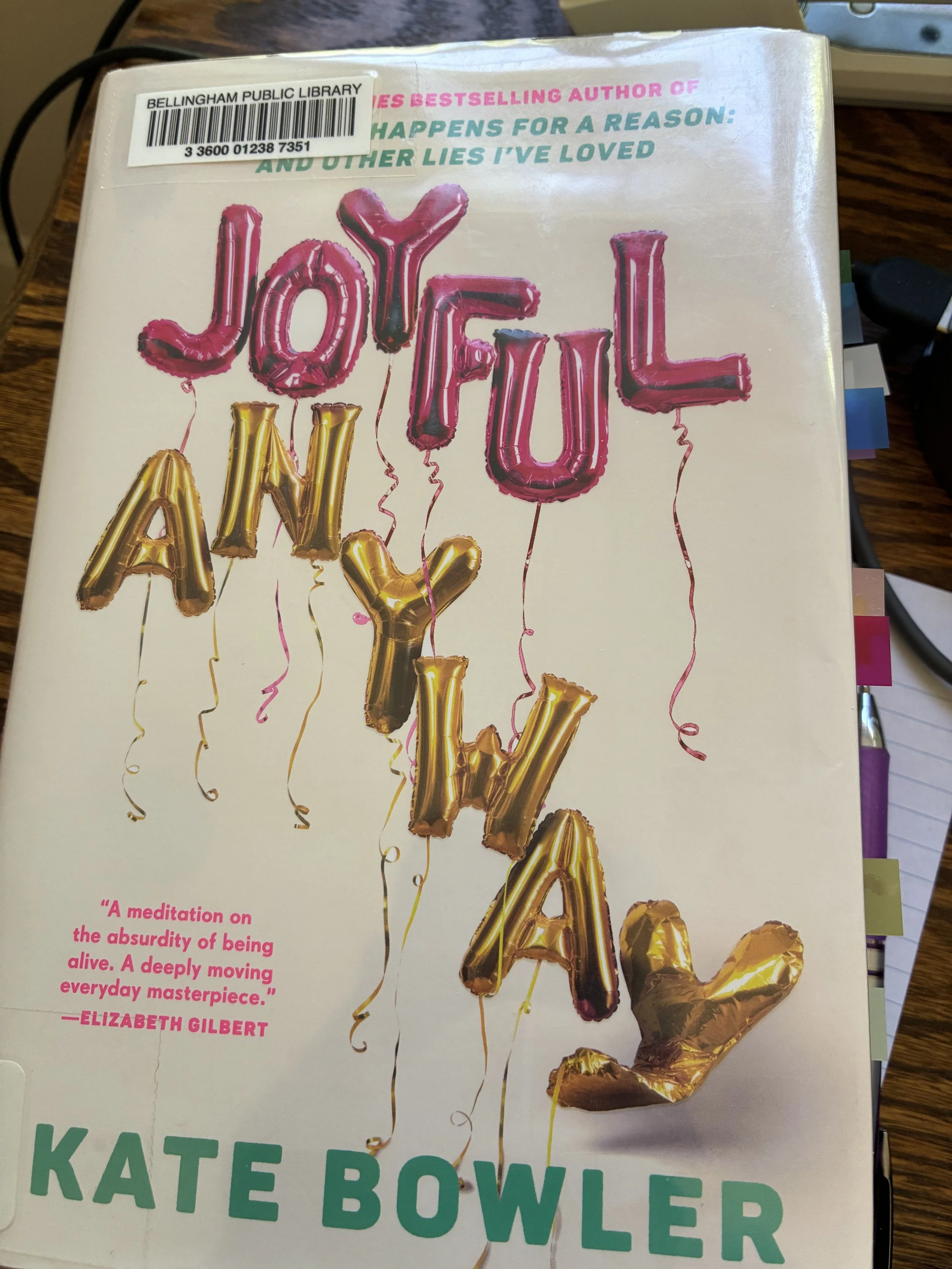
I love Kate Bowler. Her books, articles, and podcast reveal her soft heart, her gentleness, empathy, and joy. She specializes in writing about finding joy, peace, and love even in the midst of incredibly hard things. This writing about joy began when she was a young woman who had achieved her best life. She was diagnosed with stage four abdominal cancer. She had gotten her dream job as a professor at Duke University; she had married her childhood sweetheart; and after years of infertility, had a one-year-old son. Her first book was titled. Everything Happens for a Reason: And Other Lies I've Loved. Other book titles include: Have A Beautiful, Terrible Day!, The Lives We Actually Have: 100 Blessings for Imperfect Days, Good Enough: 40ish Devotionals for a Life of Imperfection, No Cure for Being Human (And Other Truths I Need to Hear).
You can tell by those titles that a unifying theme is coming to terms with bad things happening in our lives. My sister once said she wished she could tell Kate that things aren’t always so bad. A fair thought when you look at the titles. What you discover, though, is that Kate writes in an exuberant, kind, and funny way about it all. As I read this book, I thought maybe the title should have been Joyful Anyway | LOL because I laughed out loud so many times. She’s kind of a nut.
Kate got well from her cancer. After a year of planning for her death, then years of surgeries (she jokes she has had 12 belly buttons) and treatments, she has now, 10 years later, been declared cancer-free.
And now that I am technically cancer free, I am left with the health problems of a very optimistic septauagenarian. I lecture strangers about colonoscopies. I have mysterious ailments and random lumps that make people start sentences with, “Well, at least…” And like every retiree, I accept ongoing and future pain as an unwanted assignment. (page15)
The book is divided into 4 parts: The Ache, Mourning, Joy, and Living. In Part 1, I related to this passage:
We started calling it ”the ache.”
Sometimes it comes in a fleeting heartbreak. He doesn’t love me. Other times it feels like carrying an anchor sewn into the lining of your stomach. Will my body ever feel whole again? And often it is just a persistent longing, which is never satisfied by a to-do list, a rushing from task to task, or the quick kiss and an automatic “Love you” before lights out…
But the ache is not a feeling so much as a question. A question that starts with: “Will I…?”
Will I ever feel completely known?
Will I ever feel like it’s all enough?
Will I ever feel valued? Special. Supported. Less like a moron. Connected. Accomplished. Loved? (pages 23, 24)
I sometimes imagine the inside of me — my mind, my soul, the inner me — as a cave I am walking through. As I walk, I can hear the distant sound of running water. I discover an underground river. It is a comfort to me to think of that river as God’s love running under me always, even when life looks desolate and impossible to live through. I cannot see the river of God’s love, sometimes cannot hear it or feel it, but I know it’s there. When I read the above passage, I pictured that cave and river again. The ache flows in the river, too.
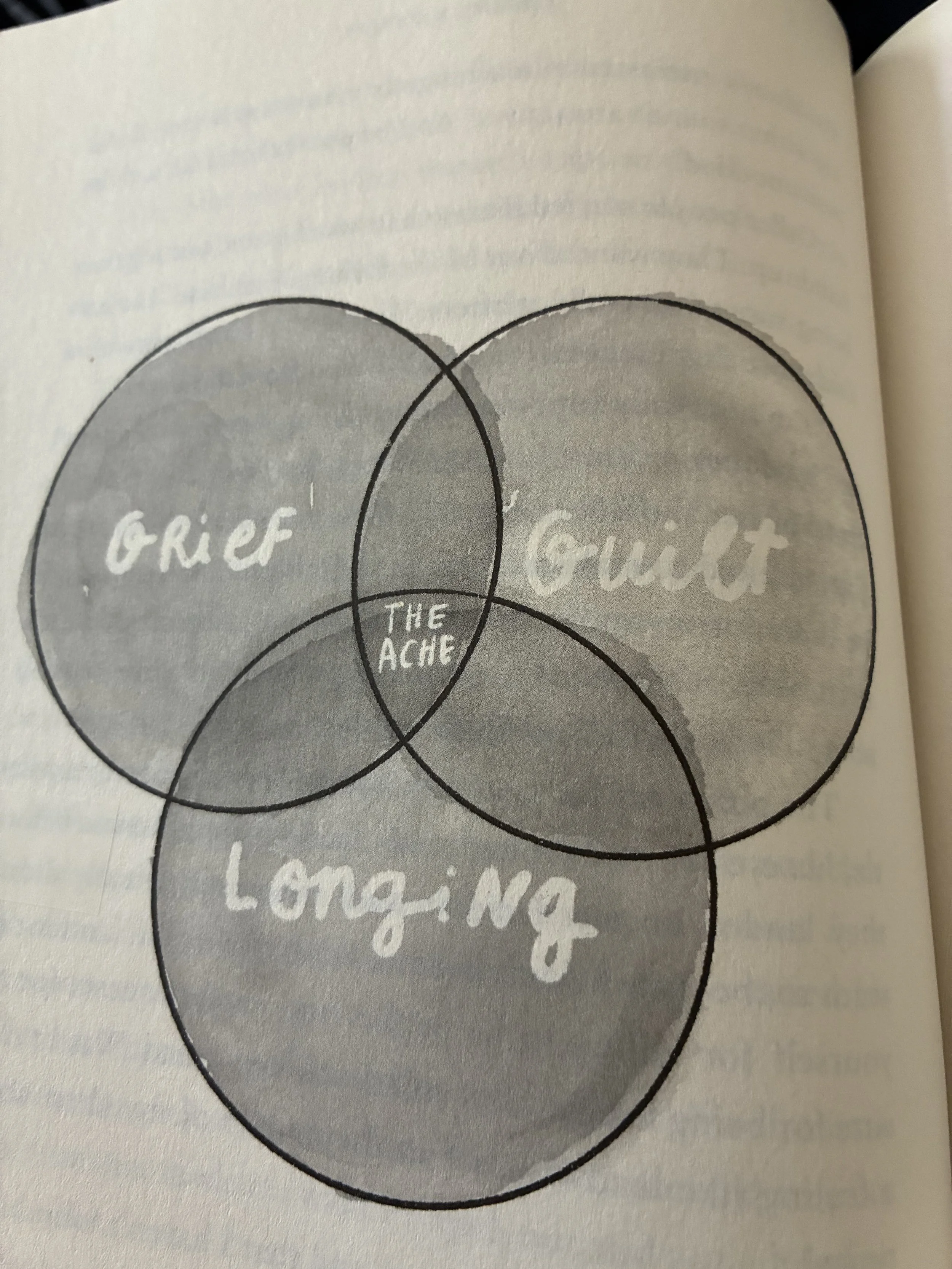
A Venn diagram of the ache, page 64
Kate writes of a conversation with an 86-year-old author and theologian “fending off advanced colon cancer” named Father Ron Rolheiser. Someone had referred her to him as someone who “knows all about this.” He quotes Saint Augustine, “I desire, therefore I am,” and says, “There’s always something missing. And I think it’s the deepest truth in everybody’s life whether they admit it or not.” He says, “it is also divine…We are made in the image and likeness of God. So, that feeling isn’t a mistake. There’s a fire inside of us. But it’s a divine fire.” Kate responds:
I guess that makes me irritated by all the false advertising I’ve been served about being spiritual. I was always taught that faithfulness is the absence of all this longing.
There’s a hole in your heart, sure, but that’s what God fills.
I have heard that, too. Like Kate, I have felt “lightly haunted by guilt” because “a better person, a better Christian, a better woman should not need, should not hunger. She would be at peace, right?”
Father Ron answers, “Kate, you and I have suffered too much in our lives to be delusional.” (Ha ha.) He talks about channeling that longing toward better aims. He quotes Karl Rahner, who said, “In the torment of the insufficiency of everything attainable, we learn that ultimately in this world there is no finished symphony.” Father Ron says:
We are going to die with a lot of hopes unfulfilled. But if you can mourn it, you can live with it. There’s a deep spiritual and psychological genius here: I need to mourn this. I can die without being fulfilled, but I can’t die with the unfulfillment not being mourned.
Kate ends with:
What do you do when nothing can change but everything must? I will need some help, but at least I know where to start: say yes to the dark unfinishedness of this symphony.
Turn your face toward the ache and say yes.
The ache? Yes.
The longing? Yes.
The grief? Yes.
The holiness of all this want? I’m not sure how, but yes. (pages 70-76)
What do you think? I like it. I like that it is delusional to think you’ll fill the hole in your heart and have peace because you have God. And I like that Kate ends with turning toward the ache and saying yes. What does that really mean? I’m not sure.
Here’s a small laugh-out-loud moment. Kate is talking to a man she’s never met at a retreat center. She tries to get a conversation going by asking him about the various activities available. She brings up one thing after another — yoga, sound bath, pottery classes — and each time he just says, “yes,” or shrugs. Then, after the latest question:
He stopped fishing in his soup enough to give me a long look, and I decided, definitively, that I am an irritating person. (page 99)
That little adjective, definitively, does it for me.
Here’s another gem, from a list titled “Joy (According to the Grief-Stricken)”:
“The absurdity of spring surprised me again this year. That somehow after my life has gone to hell, the world still blooms. Doesn’t it know?”
Right? “Doesn’t it know?” It makes me think of the scene in the movie “Four Weddings and a Funeral” with the reading of Funeral Blues by W.H. Auden.
I hope you can get an idea from what I have written of the deep meaningfulness of Kate’s writing, and her hope and delight. After Part 1, The Ache, Kate goes on with Part 2, Mourning; Part 3, Joy; and Part 4, Living. Here’s the Venn diagram of joy:
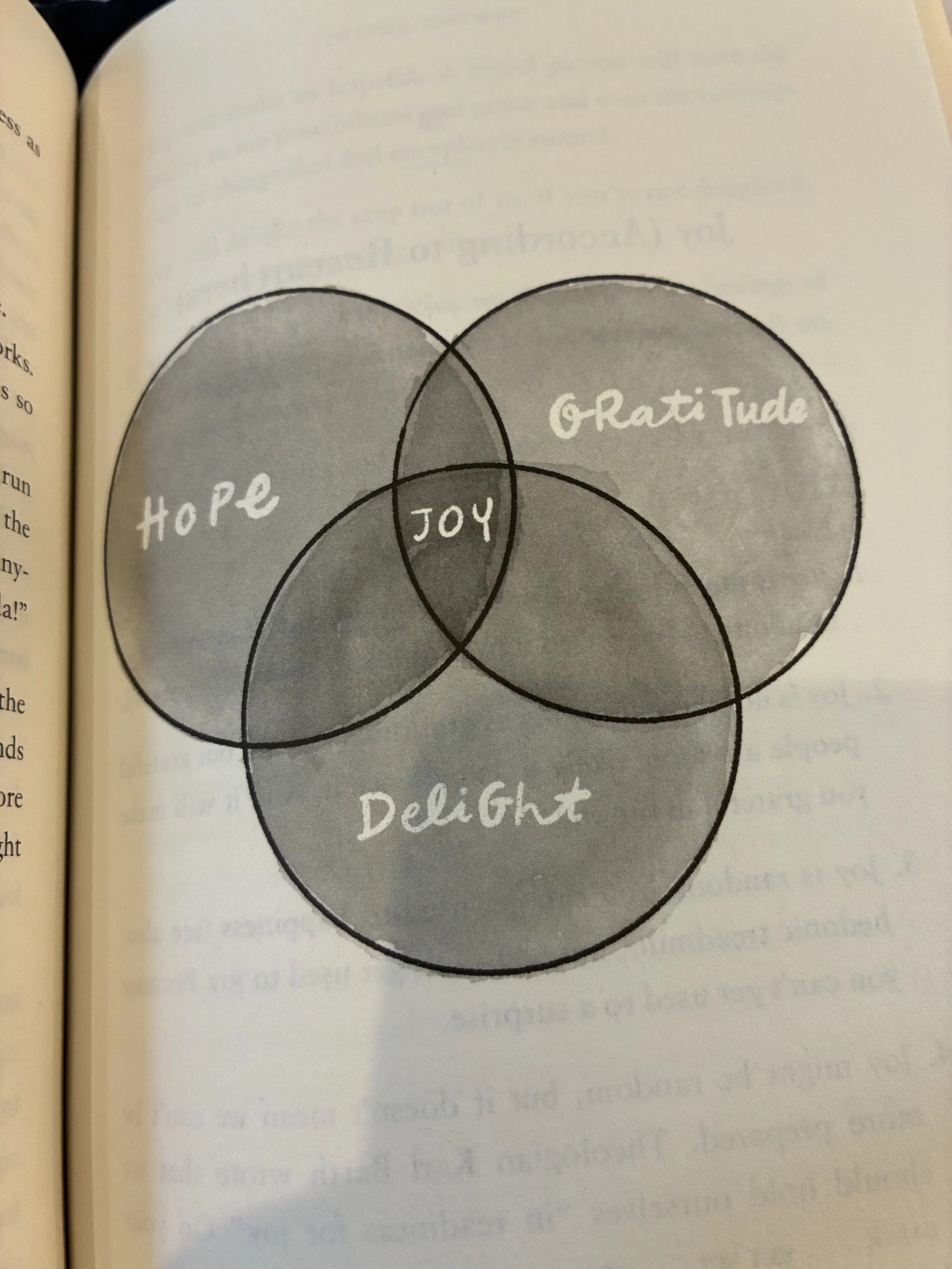
Joy, page 155.
Kate’s great. I hope you’ll read this book — and her other books, and listen to her podcast.