Theo of Golden by Allen Levi
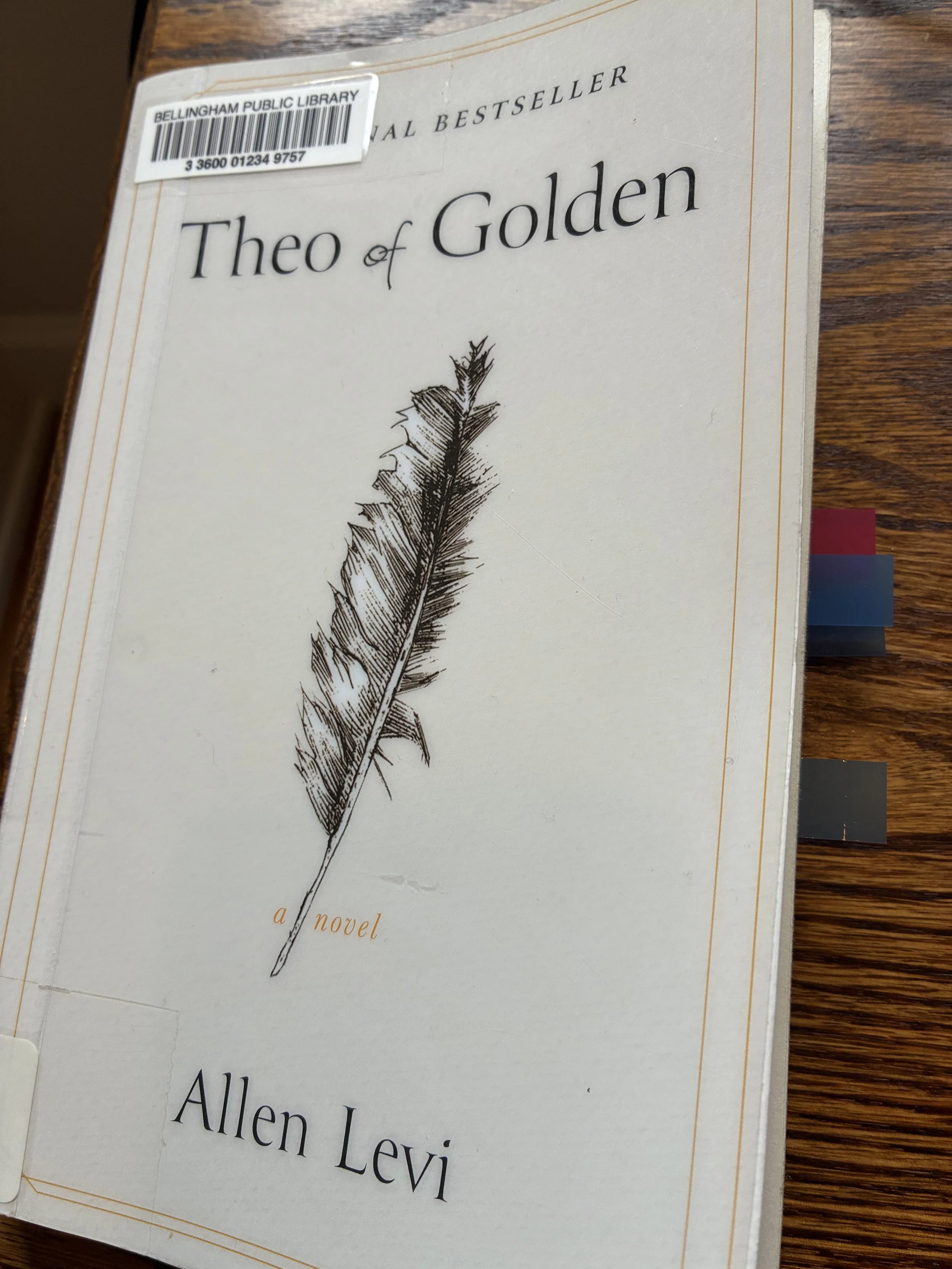
I was wrong about Theo of Golden. I started reading it before we left on a vacation and had to return it to the library unfinished. I told my sister-in-law I had started it and thought it was too sweet, too good to be true. It’s fiction, but good fiction has to be believable. She said she had thought that at first, too, but when she finished it, she was just glad she had read it. I trust my sister-in-law so I checked it out again and finished it. I, too, am glad to have read it, and I see why it got all the hype it did. (It’s a “national bestseller.”)
The story is of an old man, 87-years-old, who moves into the town of Golden, Georgia. He mysteriously goes by only his first name, Theo. He discovers a gallery of drawings hanging on the walls of a coffee shop. They are portraits of people in the town who come to the shop. Theo decides to purchase the portraits and give them to the people portrayed. Through this and the narrative of Theo’s life in the town, you get to know the other characters in the book.
At half an hour before the appointed time, they parked a couple of blocks from the fountain and then walked, holding hands, to their meeting with Theo. The sidewalk tables at the pubs and restaurants along Broadway were all occupied, and foot traffic was robust, made up predominantly of college students and other adherents to the idea that weekends begin on Thursday. The hour was a pleasant combination of cool air and sunbathed pavement. The shadows of early evening were feather soft, and joie de vivre prevailed up and down the Promenade. —page 27
Passages like this one (above) are why it felt too good to be true at first. Holding hands, weekends begin on Thursday, a pleasant combination of cool and sunbathed pavement, feather-soft shadows, and joie de vivre. It’s so idyllic. Theo and the other characters — the coffee shop owner, the artist, the homeless lady, the bookstore owner, and others — also seemed exceedingly goodhearted. Their details, though, were not all simplistic and good. You learned their histories, their mistakes in the past, and their still-existing flaws. You don’t learn, until the very end, what the mystery surrounding Theo is all about.
I am not very good at guessing the solutions to mysteries. I was surprised by the ending, and loved it.
Alex Levi is a good writer. I liked his use of words. In one place, he says that Tony, the irascible bookshop owner, “could picture the scene of the disturbance frame by frame in his bookish, cinematic mind” (page 159). I like that — “bookish, cinematic mind.” I think I have a bookish, cinematic mind.
In another passage, Theo quotes “Mr. Wordsworth.”
He once wrote that the best portion of a good person’s life is ‘the little, nameless, unremembered acts of kindness and love.’ — page 207
Little, nameless, unremembered acts of love. That’s good, isn’t it?
There was a running theme of faces, of seeing who people are in their faces, of seeing the “real-ness” of people by looking at their faces. Theo saw the people in their portraits, especially in their eyes. He got to know a man, Mr. Whitaker, whose wife and daughter were in a car accident that killed his wife and caused lifelong injury to his 7-year-old daughter. Mr. Whitaker tells his lawyer that “it might do you good to look at some faces sometimes. There are some real people in those faces” (page 258).
Mr. Derrick, let me tell you what changed me yesterday about that little man [the driver of the car that killed and maimed his wife and daughter]. Up till yesterday, all I had in my head was an idea about him. He was a ‘thing’ that hurt my little girl. And I didn’t mind what y’all did to that ‘thing.’ But what changed me was I looked at his face. Did you look? I mean really look? Not glance. Not a quick peek. I mean look?
Well, Mr. Derrick, I looked. Real good. Real hard. I looked at him. His eyes had tears in ‘em. And I saw hurt and fear and it changed me. —Page 258
I stopped and thought about that. It does make you see the real-ness of people when you look in their eyes and see tears, hurt, and fear. But what about when you don’t get to see someone’s face, perhaps because they are someone you are reading about rather than seeing in real life, or someone who has died? Or what about when their eyes have anger in them? Or are blankly staring? I do think we need to look at people’s faces and try to see them as not “other,” but humans with hearts, souls, humanity, and life, as real as we ourselves are. But often, especially living in this time of information coming at us from all directions, we need another way besides looking at their faces to realize the true humanity of people.
How do you do that — remember that the people you hear about are human, not other, just like you? I have a few things I do to try to remember. See below if you have any interest in what they are.
Have you heard of cozy mysteries? Theo of Golden is not really a mystery, but I would call it cozy. Warning: The ending is not purely happy. It’s a good ending, though. The ending is a big reason I am glad I read it. As I said, I enjoyed this book. I think you will, too.
A few things I do to remind myself others are not other; they are just like me.
Tell myself the other person is the “apple of God’s eye,” just like I am.
Remember Jesus died for us all, while we were yet sinners.
When someone has opinions I cannot agree with and even wonder how anyone could think that, I remind myself that we all contain multitudes — this person has many other traits, thoughts, motivations, and experiences. I should not think I know everything about him/her when I really only know one thing.
Those are a few. I’d love to hear what helps you.