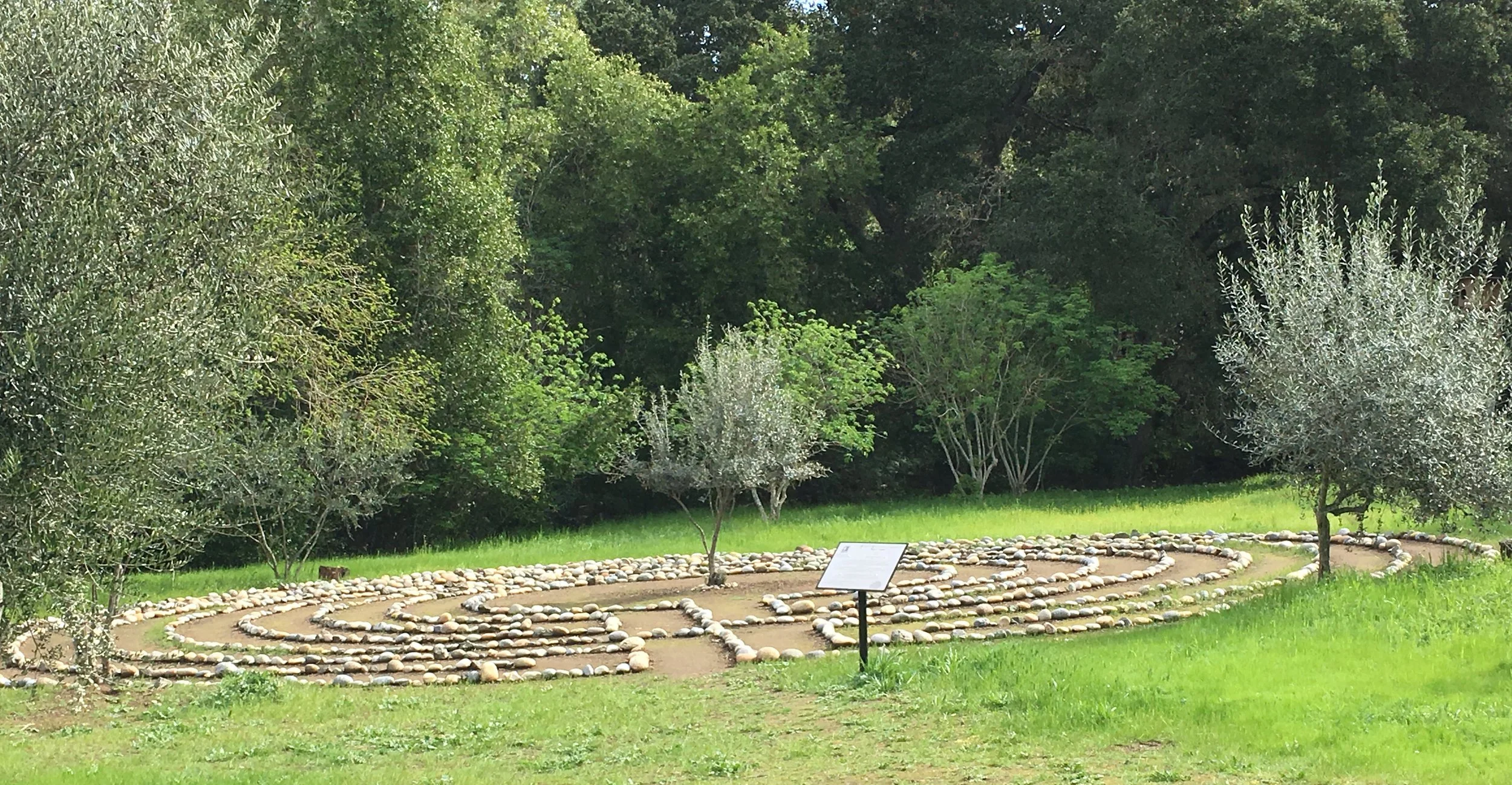
The labyrinth at the Jesuit Retreat Center, El Retiro, Los Altos, CA
I read this (below) in the daily email I receive from jesuitprayer.org (January 24, 2026). When I tell people about my transformative experience of learning about and practicing the life of a contemplative in the Ignatian tradition, the acronym MEGO often comes to mind—people’s eyes glaze over. If it’s a group setting, sometimes, by the time I finish, silence has descended, and everyone is politely waiting for me to finish. Once, a friend in the group said confusedly, “How did we get here?” I answered, “Someone made the mistake of asking me what the Ignatian Spiritual Exercises were.” The author below says, “I wonder whether a good sign of a deeply transformative experience is this sort of disconnect…” By that measure, I’m doing great!
Of course, I have to take the blame myself. I cannot seem to tell people about my transformative experience of the Ignatian contemplative life in an interesting, engaging way. It’s kind of nice to read that his loved ones thought Jesus had “gone out of his mind.”
Ever since my life was changed by what I learned about prayer, meditation, and the contemplative-in-action life that St. Ignatius based the Jesuit movement on, I have thought I would like to write a book about it, or maybe a series of essays or something. I know it is not a huge population, but I think there are other people like me in the world, whose faith is mainly based on knowledge, on what we have learned. At one of my early Ignatian retreats, when we shared the graces we had received, I said, “I feel like a path has been formed from my head to my heart,” as I touched my head and brought my hand to my heart.
I want that for others! Especially my loved ones. Yet, one of my children gently asked me to stop talking about it so much to them. My suspicion is I was coming across as pushy, or perhaps just boring. Sigh. I have written several SFDs (Shitty First Drafts—a great acronym coined by Anne Lamott) for this imaginary book. Maybe someday…
Thoughts welcome.
Mark 3: 20-21
Jesus came with his disciples into the house, and the crowd came together again, so that they could not even eat. When his family heard it, they went out to restrain him, for people were saying, “He has gone out of his mind.”
New Revised Standard Version, copyright 1989, by the National Council of the Churches of Christ in the United States of America. Used by permission. All rights reserved. USCCB approved.
Transformative Experiences
In my early years after college, I worked for four years in the Middle East. The whole experience was incredibly formative, transformative, actually. Surprisingly, it was so much more difficult to return to the United States than going over initially. We had been prepared for a culture shock initially. But there was no similar preparation to return home. I recall giving deeply reflective answers to questions from family and friends, trying to share what, for me, was meaningful. Then their eyes would kind of glaze over, and the next question was about the weather or some sports game on TV. I was confused and disappointed.
Over time, I realized that they could not possibly appreciate and understand these experiences because they were transformative interiorly. I had changed through these experiences, and they had not. This Gospel passage describes a similar sense: that Jesus’ family cannot understand or appreciate his own transformative experience and judged that he was “out of his mind.” A different Gospel passage narrates that Jesus said, “A prophet is not without honor except in his native place and among his own kin and in his own house.”
I wonder whether a good sign of a deeply transformative experience is this sort of disconnect: such an experience is beyond words, beyond the ability to adequately explain. And that the real opportunity to share this with others are not the attempts to explain in words, but in the reality of one’s life: what interests you, what you talk about, what excites your imagination and hope.
—Fr. Glen Chun, SJ, a priest of the Midwest Province, is community minister of Bellarmine House of Studies in St. Louis.
Prayer
Falling in Love
Nothing is more practical than
finding God, than
falling in Love
in a quite absolute, final way.
What you are in love with,
what seizes your imagination,
will affect everything.
It will decide
what will get you out of bed in the morning,
what you do with your evenings,
how you spend your weekends,
what you read,
whom you know,
what breaks your heart,
and what amazes you with joy and gratitude.
Fall in Love,
stay in love,
and it will decide everything.
—Fr. Joseph Whelan, SJ, typically attributed to Fr. Pedro Arrupe, SJ