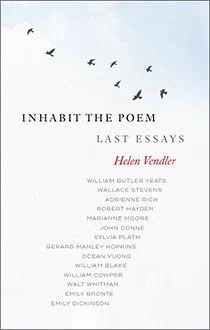
#3 - Inhabit the Poem | Last Essays - 5*
Helen Vendler
2026
My fascination with poetry is pretty recent. I’ve often thought it would be fun to take a class on poetry. Poetry Unbound with Padraig O’Tuama feels a little like a class—he reads a poem, reflects on it, then reads it again. It’s awesome. I read or heard someone talking about this book by Helen Vendler, and it sounded like a class, another way to learn about poems and poetry, that would be more scholarly. She wrote all the essays—an essay for each poem—in her last 3 years of life, and wrote the introduction 3 days before she died. They truly are her “last essays,” as the subtitle says. The introduction ends with:
For each of these poems, I hope to cast light on its imaginative originality, its escapes from cliche, intellectual mediocrity, and linguistic intertia; and its ambitious adventures in linguistic play as it searches out, for its own era, the passionate and permanent feelings of the human race.
Doesn’t that sound fascinating? Ha-ha. I know it does not to many of you, but it did to me.
In the first essay (the first chapter), I already dog-eared a bunch of pages and underlined all over the place. So rich with understanding. The first poem she writes about is The Second Coming by W.B. Yeats. The last two lines very likely sound familiar to you:
And what rough beast, its hour come round at last,
Slouches towards Bethlehem to be born?
I associated the phrase “Slouches towards Bethlehem” with Joan Didion. She wrote a book titled Slouching Towards Bethlehem, which I have heard of but never read, and I had no idea where the phrase came from. It was so interesting to learn that Yeats was writing about the second coming, describing it like:
A shape with a lion body and the head of a man,
A gaze blank and pitiless as the sun,
Is moving its slow thighs…
It was this beast that was slouching towards Bethlehem. What a strange, intriguing way to describe the second coming of Christ.
I know we enjoy poetry for many reasons—the sound of the words, the look of it on the page, the associations it brings to mind, the feel of it on our tongue, the way it makes us feel, and so on. I am grateful to have learned that we do not have to analyze the poem like a puzzle to find out what it means or what the poet is trying to say. Not being able to “figure out” poems took away my enjoyment of them. But it adds to my enjoyment to learn allusions and references I missed. That’s what these essays gave me—insights into those allusions and references, understanding of the various forms the poets were using (sonnets, blank verse, couplets, rhyme, lyric poems, etc.), and why the poet may have made the decisions he/she did.
If you have the slightest interest in learning and understanding more about poetry, this is a great book to pursue that.