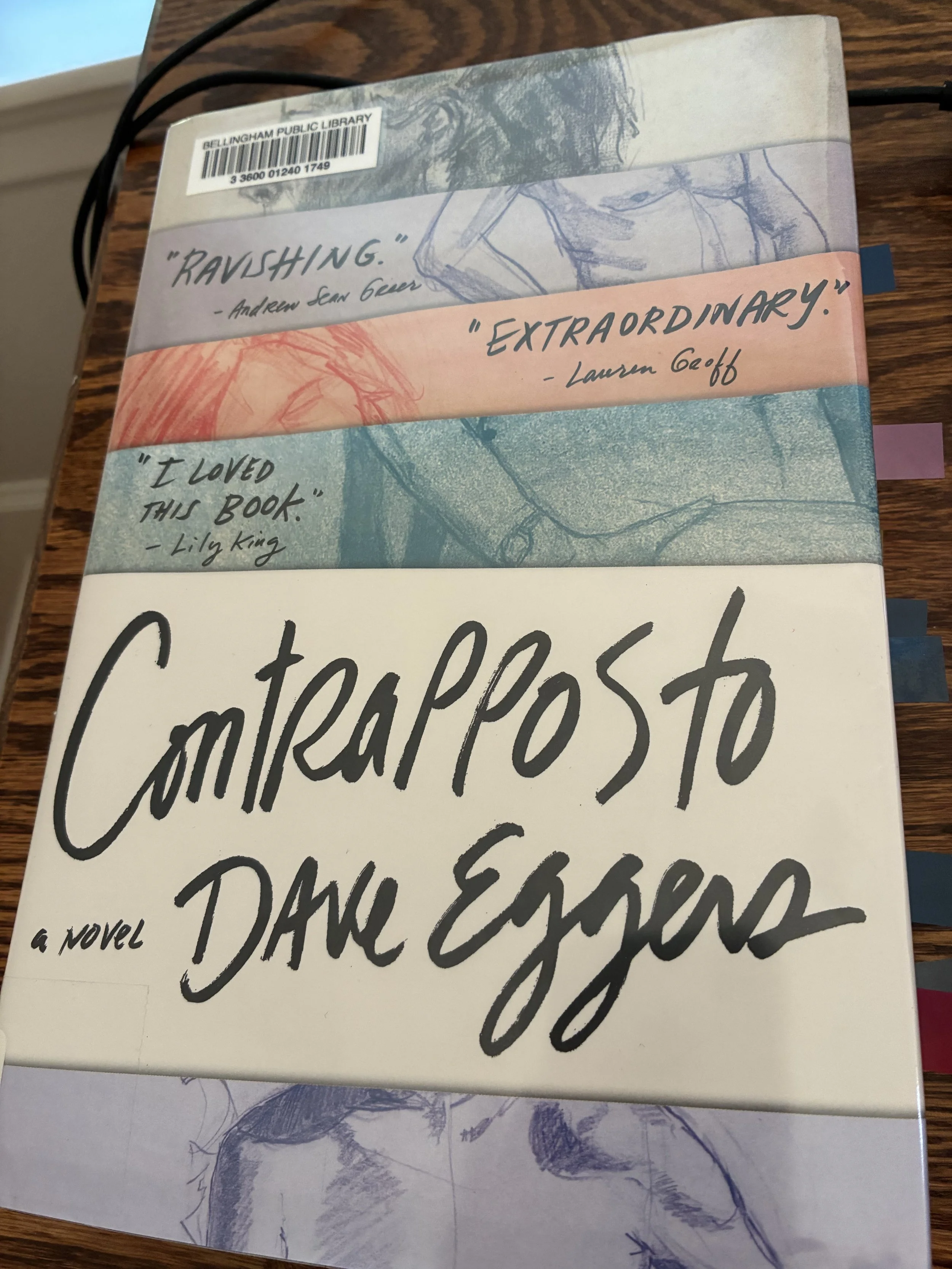
Contrapposto: “Counterpoise, in the visual arts, is a human figure standing with most of its weight on one foot, so that its shoulders and arms twist off-axis from the hips and legs in the axial plane.” —Wikipedia.
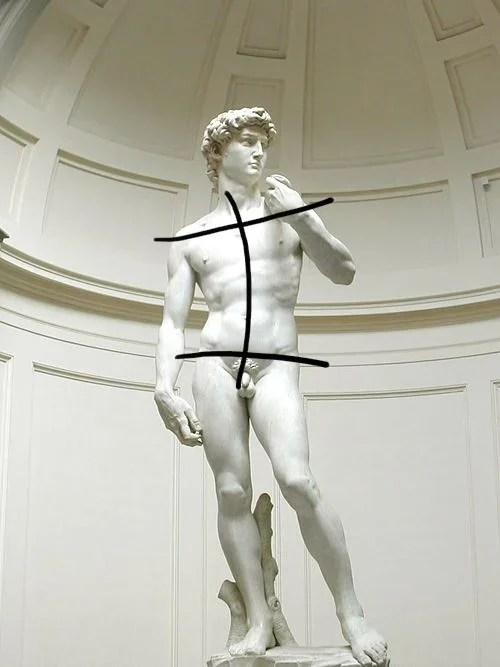
Michelango’s David, 1501-1504. Drawpaintacademy.com
This novel is about a boy (who becomes a man) from the Midwest who discovers art — his own artistic talent and art all around him. His name is Robert, but he is called Cricket because of a clicking noise he made as a child. As he is growing up, he finds ways, in spite of how poor he and his mother are, to take lessons and learn ways to make art. He dreams of becoming an artist like the medieval ones he reads about: being taken on as an apprentice and then becoming a valued artist himself. His dreams reminded me of how young boys dream of becoming professional ball players.
The sections of the book move from one stage of Cricket’s life to another. First, you read about him as a young boy, dealing with his mother’s alcoholism and tendency to get into relationships with men who are selfish, manipulative, and cruel. Following sections are about his teenage years when he meets Olympia, his longtime friend and lover, and other important characters such as his friend Jed, whom he works with; then more sections of later years, moving to various locations, and the final section when he is 74 years old. Throughout his life, he loses connection with Olympia for years, then she enters his life again. Also, throughout his life, he always makes art. Mostly he draws portraits, but he also learns to paint, does carpentry work, and many other types of labor to support himself.
Olympia and Cricket are idealistic, quirky free spirits. Cricket lives a free-spirit kind of life. Olympia has more money in her family and goes to university, studies abroad, and ends up becoming quite wealthy. Always, though, art is central to both their lives. In her case, she does not create art; she knows it and uses that knowledge to make money. For example, she opens art studios, finds artists and people who buy the art. In another period of life, she advises wealthy clients where to find art and what to buy.
I enjoyed some parts where I learned a little about strategies artists learn. In an early class, Cricket’s teacher says, “How many of you have seen films or photos where an artist will stick out their thumb and squint?” She explains there’s actually a reason for this trope. It’s for measuring. The artist fully extends their arm with their thumb up (extending it fully so it’s the same every time), then they cover the model’s face with their thumb, and that is their unit of measure. “Everything else on the model will be measured in the number of the model’s heads.” The teacher instructs them to count how many heads tall is the body, how many heads down to the shoulders, arms, and legs, how many heads long are each. The student artists were surprised by the numbers. The rough guide they came up with was:
The human figure is about 7.5 heads tall.
Two heads down from the top of a figure is the line of the nipples.
Three heads down from the top of the figure is the navel.
Four heads down from the top of the figure is the pubic bone.
The pubic bone is pretty much the middle point of the body.
The wrists line up with the top of the femurs.
The elbows line up with the navel. —page 66
Cool, huh? Eggers is an artist himself and the book contains drawings by him and others.
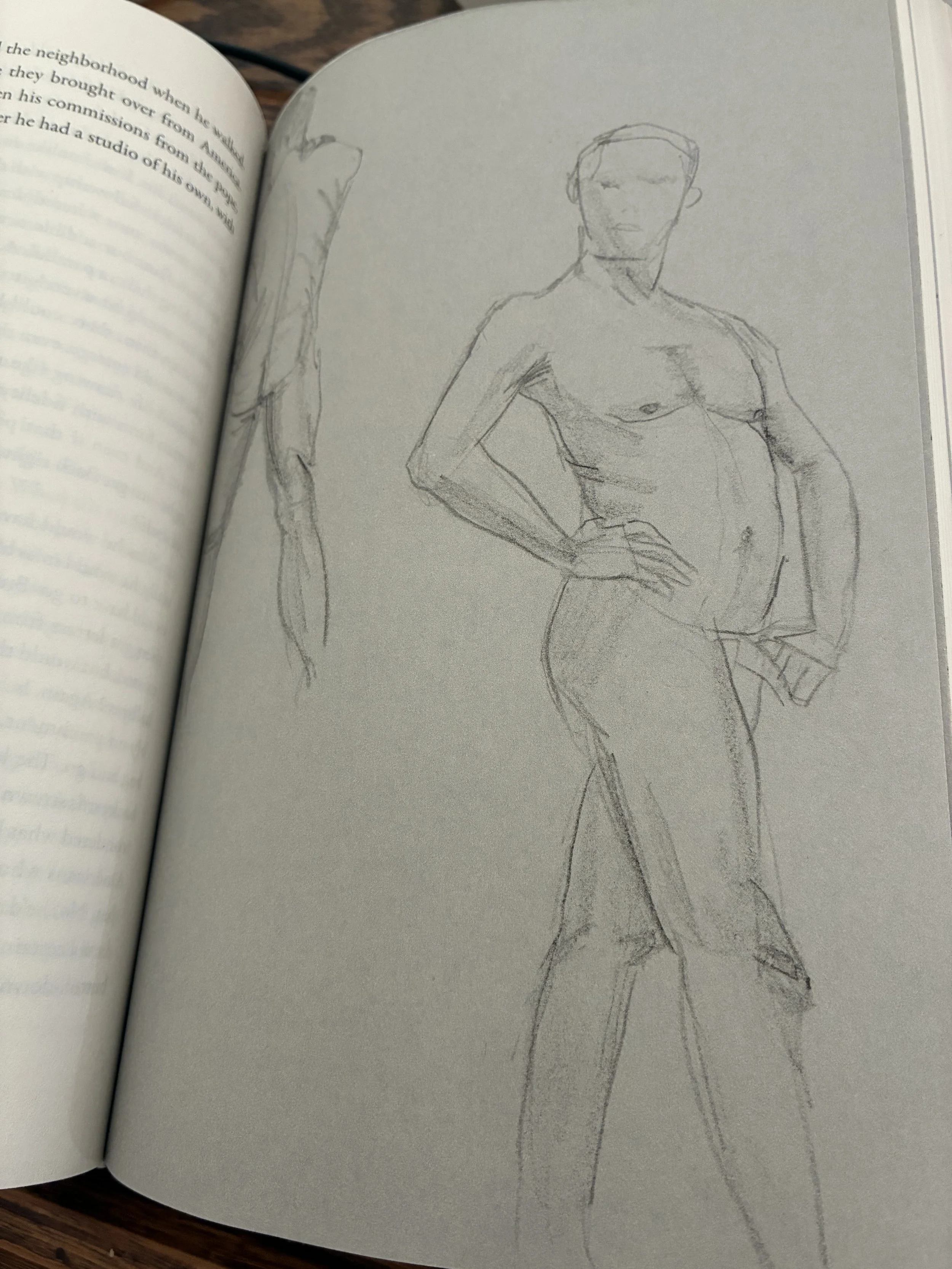
Cricket was “surprised by the role of sheer doggedness — the determination to get it right.” —page 68. That is kind of surprising, isn’t it? When you see the work in progress by artists, whether it’s visual art like drawing and painting, or written art, or something else, when you see the sketches, drafts, and attempt after attempt to get it right, you realize there is so much time and effort expended before what you see — the finished piece. In my head, I sometimes imagine someone sat down and created this beautiful thing I see, that they are so talented it comes forth from them like water from a fountain. I don’t think of the hours and hours of trying and practice that went into its creation.
It also reminded me of another kind of doggedness, or maybe you can call it patience with tedium. I follow an artist who draws very detailed images with tiny little designs filling the images. She has to sit there drawing tiny leaves (or diamonds or lines or whatever) over and over, hundreds of times, to make the drawing look the way she wants. I took a class on sketching and realized, to do it right, I would have to do what felt quite boring — repeatedly draw blade of grass after blade of grass, or branch after branch, or whatever.
There was an interesting scene in a session in an art school. The students would get together to critique each other’s work. One of them would display a piece of their work and talk about why they made it and what they wanted it to convey. In the session Cricket sits in on, it becomes quite cruel. A talented student, eager to share her art and the love she has for it is ripped to shreds by her fellow students. A professor Cricket ends up becoming a friend of stands up and yells:
Beauty justifies itself! There is a perfectly inverse relationship between talent and the need to explain itself. The artist’s only rational response to ‘Why did you make this?’ is ‘Because I wanted to’ or ‘Because it felt right.’ Everything else is sophistry. —page 168
Later, they have an interesting discussion about how doing art to please themself isn’t everything. “But what you paint isn’t just about what you want to paint. It’s also about what people want to see now.” —page 191. Art that makes the artist personally happy must also be good. The same professor who cried out about the cruel critiques says, “You can have all the skill in the world, but without an idea — something that delights or challenges the mind — it probably falls short of being art.” —page 193.
This might make it sound like the book is full of lofty speeches about art. It isn’t! The story of Cricket, Olympia, what they each do in their lives, where they go, who they live by and with, and their friendship throughout is interesting and enjoyable to read. I am overdue in getting the book back to the library, which I feel guilty about because someone else is waiting. But I so wanted to finish it, I read as much and as quickly as I could in the couple days after it was due.
Cricket and Olympia live in many places — Indiana, Cambodia, Vietnam, Thailand, Chicago, Paris, and Turkey. The people they interact with are funny, weird, and crazy. Some of the jobs Cricket does are strange and dangerous, like finding objects in stranded ships in order to sell them. In that job, someone searching on the floor above him finds explosive material and the blast gives Cricket burns that severely curtail the use of his arms for the rest of his life.
Olympia kind of sails in and out of Cricket’s life. They go off and live apart from each other for years at a time, sometimes keeping in touch, sometimes not. Each of them finds love with others and then, when they reconnect, again find love with each other. In the last chapter, when they are both in their 70s, Olympia comes to Cricket’s art class as a model calling herself Antoinette. She has promised to pose with another person as the life model for the class. Ann-Marie, one of the leaders says,
“This is Antoinette. And you had someone else?”
“That one. Up there,” Olympia said. She dropped her robe, her body gold and bright and lean, and pointed to Cricket. “He said he’d join me.”
Cricket hadn’t seen this part coming. Twenty-two heads turned to him.
“I did not say I’d join her,” Cricket said. “This is Olympia, not Antoinette,” he said to the class. “We’ve known each other sixt years.”
“Sixty-two,” Olympia said, still nude… “Join me,” she said to Cricket, with just enough urgency and need that he worried that there was more to this than theater.
“It’s my birthday,” she said to the class.
“It’s not her birthday,” Cricket said.
At this point, the class had gone from amused to confounded. —page 409.
I highly recommend Contrapposto. I hope you’ll read it. Dave Eggers is an interesting guy, too. He lives in San Francisco and I’ve seen him many times at Kepler’s Bookstore in Menlo Park. I first heard of him when I read his first book, A Heartbreaking Work of Staggering Genius. It’s a memoir of when he, as a young man, ended up raising his younger brother when both his parents died. It’s a funny, weird, crazy book, and I immediately wanted to keep reading what he wrote. He also tries to do good in the world. He started a school and other programs to encourage kids to develop their talent, and he looks for ways to get art out into the world for everyone.