American Han by Lisa Lee
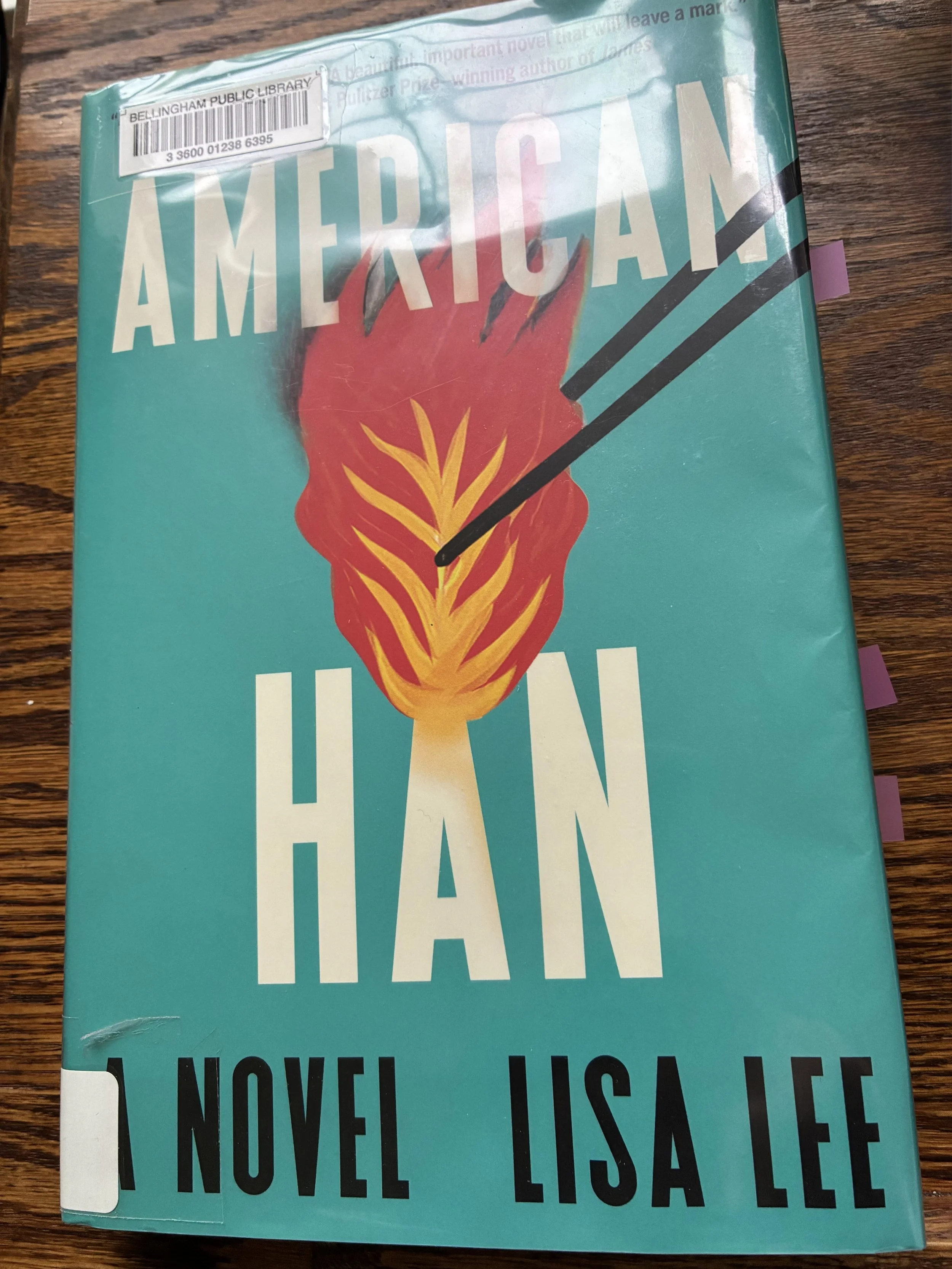
American Han - 5*
Lisa Lee
The narrator in this novel is Jane, the daughter of Korean immigrant parents who live in Napa, CA. When the story begins, she, her parents, and her brother are all living in various parts of the Bay Area. Having lived there myself for 45+ years, it was fun to read of familiar places.
The Bay Area spans far and wide, from the city of San Francisco to the surrounding counties, extending, officially, from the wine country, the headlands, the parka and campgrounds in the north, to Silicon Valley in the south, with its strip malls and tech headquarters and massive parking structures and Asian grocery stores, and from the East Bay with its clusters of immigrant suburban communities and mini cities, the little crunchy haven of scholars and social progress, next door to the Bay’s old refuge of hip-hop now gentrified by tech overflow and hipsters and artists, all the way over to the Peninsula with its preppy athletic spirit, sanitized by technology, industry, and the future. (page 61)
A lot of the story hinges on the Korean-American upbringing Jane and her brother Kevin experienced. Near the beginning, Jane is surprised by her mother’s benevolent acceptance of what Jane told her. “I wanted the old mom back. I wanted the old mom so I could tell her that she fucked me up. Then I would be satisfied in hating her.” (page 25) This reminded me of a poem by Philip Larkin that begins with the line “They fuck you up, your mum and dad.”
Jane doesn’t claim to know whether all Korean parents mess up their children the same way hers did. The things her mother and father did were hurtful (both mentally and physically), sometimes incredible, sad, and, once in a while, funny. At one point, Jane writes that her mom told her that her job as a mother was to make sure Jane and her brother always obeyed her, and that their job was to take care of her. She wanted her daughter to learn to cook and clean, to either make a lot of money herself or to marry a man who did and have lots of babies. Jane wonders if her mother knows that cooking, cleaning, and taking care of the family is the mother’s job in America. It doesn’t seem so.
Kevin’s job was to become the head of the family and make enough money to care for his parents. As a girl, Jane did not get all the advantages her brother did. Kevin went to an expensive private school; Jane went to a good public school. They both got tennis lessons, but Kevin’s were more carefully attended to. Jane was told that Kevin would inherit everything. It was all about Kevin becoming a success, making his parents proud, and being able to show off to their friends.
Her father works very hard to earn enough money to give the family a high status, so he is often away, working many hours a day. When he is around, he is sullen and angry and has sudden fits of rage, including hitting his wife and children. By the time the novel starts, he has lost his last entrepreneurial ownership of a small business that made up his career (convenience stores, diners, restaurants, and car repair shops), and is starting a position as a semi-truck driver. Suddenly, he is happy and thrilled to be able to travel to many places he has longed to see, and to be an employee with a boss and good benefits.
My mother once told me that her parents didn't give their children compliments because they didn’t want them to “get a big head” (become conceited). She said when she got a new outfit, her parents would tell her the dress was nice, but would never say she looked pretty. Jane and Kevin’s parents went way, way beyond this with their children. They told their children repeatedly that they (the children) were not doing enough, that they were failures, never measuring up. Still, they scrimped and saved to give them every advantage they could—private school, tennis lessons, tutoring, music lessons, and so on.
Yet at the same time, her parents never encouraged Kevin and, in fact, told him over and over that he wasn’t doing enough. Kevin told Jane many times that he tried and tried, and no matter what he accomplished, it was never enough. Jane, on the other hand, quite easily made high grades and did well in tennis and other endeavors. This made Kevin very jealous of Jane. Although Kevin and Jane had some good times together, especially while they were young, Kevin came to believe that all his failures to measure up were Jane’s fault and that Jane was their parents’ favorite.
Jane’s mom blamed Jane for everything, too. Even when her father or brother hit her, Jane’s mom would say it was her fault; she had made them mad. Once, Jane’s mom told her that she wished that Kevin had gotten some of her luck.
“It’s okay that he’s not handsomem: she said, “He’s not a girl, so it’s okay. It’s important for girls to be pretty. I just wish he was smart. One day he’ll be a man—he should be the one who gets to be smart, not you. I wish he was talented. Everything is so easy for you but he tries so hard and he’s never the best.” (page 219)
So, yeah, her parents fucked them up. Big time. As you read, you see foreshadowing of a major event involving something Kevin does.
I wondered why the book was titled American Han. I thought the family’s last name would be Han, but it wasn’t; it was Kim. By the end of the book, I still didn’t know. If there was a reference in the text, I missed it. So I googled “han.” It turns out “han” is a word many writers say is untranslatable. This article by Kristin Wong contains a lot of interesting information about the word han.
Like most untranslatable words, it isn’t easily defined, but “han” has been described as a profound blend of sorrow, regret, anger, and longing. It’s a collective emotion, and it can be an inherited one, too. (“Han: A profound, ancestral anger,” from the Substack newsletter untanslatable, by Kristin Wong, Dec. 20, 2024)
Some say han is a uniquely Korean experience, but Minsoo Kang, a professor of history at the University of Missouri-St. Louis, writes about its problematic origins(which he compares to the way the word “hysteria” has been used against women) and how Korean han has become something of a stereotype. (same as above)
Google also linked to an interesting poem called “American Han,” by E.J. Koh on Poetry Foundation.
It’s a good story. Good writing. I read it quite quickly. Highly recommend.